
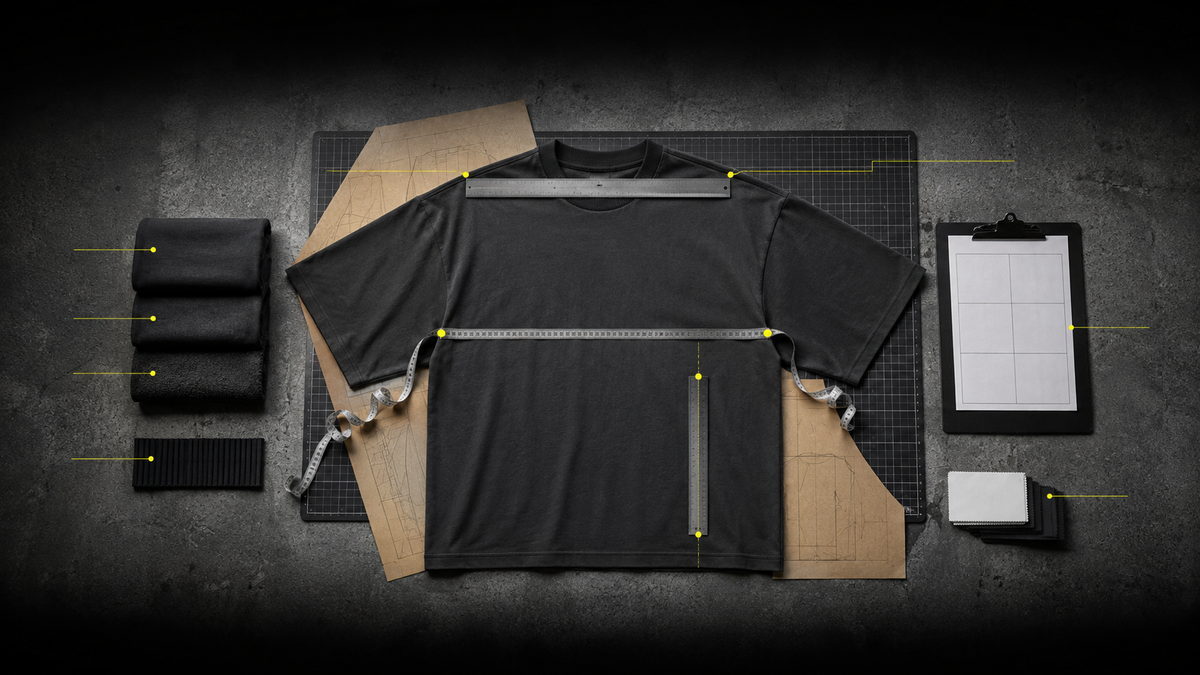
An oversized T-shirt should look deliberately proportioned, not like a regular tee bought two sizes too large. The difference is built into the pattern: where the shoulder drops, how much chest ease is added, whether the body is cropped or long, how the sleeve balances the width and whether the collar still controls the neckline. Those decisions must be written into measurements and confirmed on a sample before bulk.
Manufacture an oversized T-shirt from a purpose-built base-size block, not by scaling every measurement equally. Define the shoulder, half chest, body length, sleeve length and opening, neck width, collar and hem; then grade those proportions across the size range. Choose GSM for the intended drape — roughly 180–220 GSM for a softer relaxed result, 220–260 GSM for balanced structure and 260–320+ GSM for a dense heavyweight silhouette — but approve the actual knit, finish and wash because GSM alone does not predict the final hand or fit.
Oversized, boxy and simply sized up are not the same
Oversized
Built with intentional ease through the shoulder, chest and sleeve while controlling length, neckline and hem. The silhouette can be long, balanced or cropped.
Boxy
Usually wider through the body with a comparatively shorter length and straighter side seam. It may be oversized, but “boxy” mainly describes width-to-length proportion.
Drop shoulder
The shoulder seam sits beyond the natural shoulder. It is one component of many oversized fits, not a complete specification by itself.
Regular tee sized up
Every dimension grows according to a standard grade, often making the neck, armhole and body too long without creating the intended fashion silhouette.
Start with a visual target: relaxed and draped, square and cropped, vintage heavyweight or longline. Then translate that target into a measured base size instead of relying on the word “oversized.”
The measurements that define an oversized T-shirt
The T-shirt tech pack should identify every point of measure, the measurement method, base-size value, tolerance and grading rule. These are the measurements that most strongly control the silhouette:
Across shoulder
Controls how far the seam extends beyond the natural shoulder. The amount must work with the armhole and sleeve, not be chosen in isolation.
Half chest
Sets the body ease and visual width. Measure at a named distance below the armhole so the factory and brand use the same point.
Body length
Separates a cropped boxy tee from a long oversized tee. Measure from a defined high-point shoulder or centre-back reference.
Sleeve length
Must state whether it is measured from the dropped shoulder seam or from centre back. The two methods produce different numbers.
Bicep & sleeve opening
Control whether the sleeve feels wide and straight, tapered or restrictive. They must balance the lower armhole and intended sleeve length.
Neck width & drop
Keep the neckline intentional. A wider body does not automatically require an enlarged neck opening.
Bottom opening
Defines whether the side seam falls straight, narrows toward the hem or creates an A-line shape.
Collar dimensions
Rib height, finished length, attachment ratio and stitch construction influence recovery, waviness and the final visual weight of the neck.
Include a flat sketch and measurement diagram so similar-sounding points cannot be confused. If a reference garment is used, record its measurements after conditioning and state every intended change. “Like this, but more oversized” is not a producible instruction.
Build the base size before grading the range
The base size is where the silhouette is designed and approved. Choose the size that best represents the core customer, then evaluate it on an appropriate fit model or body rather than judging only on a table.
Check the garment from front, side and back, and test movement:
- Does the shoulder seam sit at the intended point without pulling the neckline?
- Does the chest create controlled volume rather than collapsing under the arm?
- Is the body length balanced with the width and intended trouser rise?
- Do the sleeves clear the elbow or sit at the planned point?
- Does the hem stay level when the wearer moves?
- Does the neck sit flat without feeling loose or restrictive?
After the base size is approved, grade the range deliberately. A fixed increase applied equally to shoulder, chest, length, sleeve and neck can distort the silhouette at the smallest and largest sizes. Review the size extremes or a size set when the fit is highly directional.
Choose GSM for drape, structure and use
GSM measures fabric mass per square metre; it does not measure softness, yarn quality, density, stretch or recovery. Use it as one input alongside cotton type, knit construction, finish and wash. For the wider fabric area of an oversized pattern, the weight also affects garment cost, packed weight and how the tee hangs.
180–220 GSM
A lighter, softer oversized tee with more movement and drape. Check opacity, seam stability, collar balance and how the body behaves after wash.
220–260 GSM
A balanced premium range for many structured everyday and streetwear fits. It can hold a boxy shape without the bulk of the heaviest jerseys.
260–320+ GSM
A dense heavyweight direction with stronger structure and visual weight. Fabric consumption, needle and seam setup, wash behaviour, packing and freight all need consideration.
Composition & finish
Combed cotton, open-end cotton, blends, enzyme wash, pigment dye and other finishes can make the same nominal GSM feel and perform differently.
Use our T-shirt fabric and GSM guide to compare yarn, knit and weight in more detail. Always approve a physical swatch or sample in the intended finish instead of ordering from a GSM number alone.
Collar and shoulder construction carry the silhouette
An oversized body puts visual emphasis on the neckline and shoulder line. Small construction differences are easy to see:
- Collar rib: specify composition, rib structure, finished height and recovery. A heavyweight body may need a collar with enough visual and mechanical strength to balance it.
- Neck opening: confirm width and front/back drop independently from body width. An accidentally enlarged opening makes the tee look stretched rather than oversized.
- Shoulder tape: can help stabilise the shoulder and back neck, especially on a wide or heavy body.
- Armhole and sleeve: the dropped shoulder, armhole depth, bicep and sleeve cap must be developed as one system to avoid folds or restricted movement.
- Side seams: support a controlled custom silhouette and size grading. If tubular construction is proposed, confirm available body widths and twist performance.
- Hems: specify finished depth, stitch type and any coverstitch or twin-needle appearance appropriate to the fabric weight.
Shrinkage can change the intended proportions
A tee can meet measurements before washing and miss the silhouette afterwards. Cotton knit may change in length and width; garment dye, pigment wash and other finishes can add further movement. The effect depends on the yarn, knit, finishing process and care method, so a universal shrinkage allowance is not reliable.
State whether the measurement chart applies before or after wash, agree the conditioning method and test the intended fabric and finish. If the design uses a carefully cropped length or precise sleeve position, small dimensional movement can change the look more than it would on a regular tee.
Plan print and embroidery for the finished pattern
Artwork placement should be measured from stable garment points, not positioned by eye on a digital mock-up. On an oversized tee, a standard print can look too small or sit too high because the chest, shoulder and body length have changed.
- state artwork width and height, not only a percentage scale;
- measure placement from high-point shoulder, centre front, neckline or another named reference;
- confirm whether one artwork size is used across all garment sizes;
- check print hand and stretch against the chosen jersey;
- allow for seams, pockets, washes and any distortion caused by garment processing.
Compare screen print, puff, DTG, water-based print and embroidery in our garment print methods guide, then approve the technique and placement on the intended fabric.
Sampling turns “oversized” into an approved standard
The first fit sample should answer whether the proportions work. Measure it against the tech pack, photograph it consistently and record corrections by point of measure. If the silhouette changes, update both the pattern and the written chart so the next round is not working from conflicting information.
The PP sample should then confirm the intended bulk fabric, collar rib, stitching, wash, labels and decoration. Approve it in writing and retain it as the physical reference for bulk. For directional fits, consider checking a smaller and larger size before cutting the full size range.
During bulk, inspection should verify the critical measurements, graded proportions, collar recovery, shade, wash result and artwork placement against that approved standard. Define the defect classes and sampling decision before production using our garment quality control and AQL guide.
MOQ and cost drivers for oversized T-shirts
Lesstell's MOQ starts from 50 pcs per style, subject to the selected fabric, colour, size split, labels, decoration and finishing. An oversized T-shirt can use more fabric per unit than a regular block, and heavyweight jersey increases both material consumption and packed shipment weight.
The main quotation variables are:
- fabric composition, GSM, width, colour and whether custom knitting or dyeing is required;
- pattern size and fabric consumption across the size range;
- collar rib and any custom neck construction;
- print or embroidery method, coverage, colour count and placement;
- garment dye, pigment wash, enzyme wash or other finishing;
- labels, tags, packaging and testing requirements;
- quantity by colour and size, plus the intended delivery method.
If demand is still being validated, compare the inventory and unit-cost trade-offs in our small-batch vs bulk clothing production guide.
Oversized T-shirt specification checklist
- Reference and intent: front, side and back silhouette references, target customer and fit description.
- Base-size measurements: shoulder, half chest, length, armhole, sleeve, bicep, opening, neck, collar and hem.
- Measurement method: diagram, named reference points, garment condition and tolerance.
- Grading: rules for every size and any size-set review requirement.
- Fabric: composition, knit, GSM, colour, finish and approved swatch.
- Construction: collar rib, tape, seam and hem details.
- Decoration: production artwork, size, placement, technique and colour reference.
- Wash performance: test method and whether measurements apply before or after wash.
- Branding and packing: labels, hangtags, bags or alternatives, fold method and carton requirements.
- Approval: written fit comments, PP sample status and bulk inspection standard.
Lesstell develops custom oversized tees from a tech pack, reference garment or design direction, then confirms the pattern, fabric, collar, decoration and finish through sampling before bulk. Explore our custom T-shirt manufacturing service or our private label T-shirt manufacturing program for labels, tags and packaging under your brand.
Oversized T-shirt manufacturing FAQ
Is an oversized T-shirt just a regular T-shirt sized up?
No. A purpose-built oversized pattern controls shoulder extension, chest ease, body length, sleeve proportion, armhole, neck and hem independently. Simply sizing up a regular block often makes the garment too long and enlarges areas that should remain controlled.
What GSM is best for an oversized T-shirt?
There is no universal best weight. Roughly 180–220 GSM gives a softer drape, 220–260 GSM gives balanced structure and 260–320+ GSM creates a denser heavyweight direction. Yarn, knit, finish, wash and pattern affect the result as much as GSM, so approve the physical fabric.
What is the difference between boxy and oversized?
Boxy mainly describes a wide, relatively short width-to-length proportion. Oversized describes intentional extra ease through the silhouette and can be cropped, balanced or long. A tee can be both boxy and oversized, but the terms are not interchangeable specifications.
How do you stop the collar stretching on a heavyweight tee?
Specify a suitable rib structure, composition, finished height and attachment ratio; control the neck opening; stabilise the shoulder or back neck where appropriate; and test recovery and wash behaviour on the actual fabric. A heavier body does not automatically guarantee a stronger collar.
Can a manufacturer copy the fit of a reference oversized T-shirt?
A reference can be measured and used as the starting block. Record what should stay and what should change, document the new measurements in a tech pack and confirm the result on a physical sample before bulk.
What is the MOQ for custom oversized T-shirts?
Lesstell's MOQ starts from 50 pcs per style. The workable colour and size split depends on the fabric, colour, collar, decoration, labels and finishing, so it is confirmed with the complete specification.