
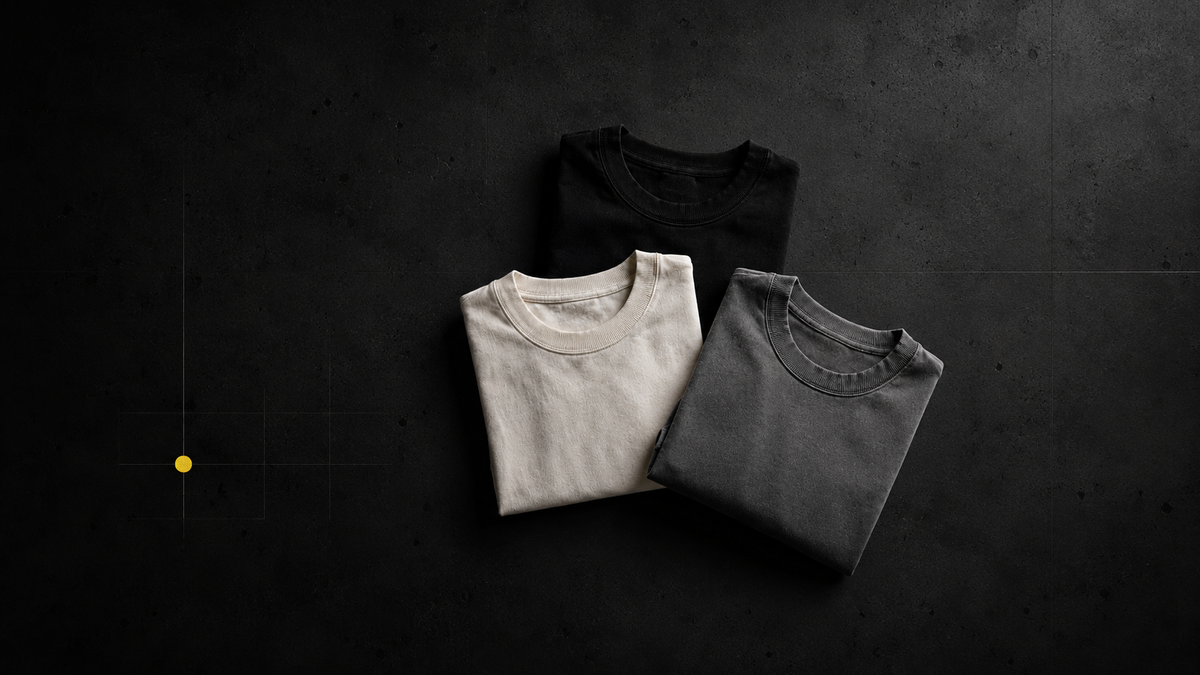
GSM in T-shirt fabric means grams per square metre—the weight of the fabric, not a direct quality score. Use 180 GSM, 220 GSM and 230 GSM as comparison points when sampling: the right choice depends on the intended fit, climate, opacity, yarn, knit and finish.
A T-shirt is the hardest "simple" product to get right. Customers judge it in the first three seconds — by weight in the hand, how the cotton feels, and how it hangs. Two tees can look identical on a screen and feel worlds apart in person. Here is what actually decides whether your tee reads premium or cheap, from a manufacturer's side.
For everyday through heavier streetwear tees, compare fabrics around 180–240 GSM, then confirm the cotton specification, knit, fit and construction. Review the collar, shoulder tape, hems and wash performance together; GSM alone does not establish quality.
1. Fabric weight (GSM) — the first thing buyers feel
GSM (grams per square metre) is the quickest read on how substantial a tee feels. It describes fabric mass per unit area; yarn, knit density, finishing and garment construction also affect how the tee feels and performs:
- 140–160 GSM: a lightweight option for warm weather and layering. Check opacity in the intended colour and fit; a lower GSM is not automatically lower quality.
- 180–200 GSM: a useful starting range for everyday tees. Compare softness, drape and opacity on the actual fabric.
- 210–240 GSM: a heavier starting range for structured or relaxed streetwear tees. The cut and finish determine the final silhouette.
- 250 GSM+: a heavier option for substantial tees. Confirm comfort, drape and decoration compatibility through sampling.
Choose the weight around the product brief rather than a universal quality threshold. A lightweight tee can be well made, and a heavy tee still needs suitable yarn, construction and finishing.
2. Cotton type — why two 200 GSM tees feel different
Combed ring-spun
Combing removes shorter fibres before spinning. Combed ring-spun cotton is a common option for a smooth hand-feel; compare the actual fabric as yarn and finishing choices still matter.
Carded and combed yarn
Carding and combing describe fibre preparation; ring-spun and open-end describe spinning methods. Carded cotton can also be ring-spun. Confirm both the preparation and spinning method when comparing fabrics.
Organic cotton
GOTS-certified organic cotton options can be sourced from certified mills, subject to the applicable supplier scope and order documentation. See our certified organic and recycled fabric standards guide before making product claims.
Blends
Cotton/poly and other blends offer different hand-feel, drape and care characteristics. Confirm fibre percentages and wash performance on the selected fabric.
Two fabrics with the same GSM can feel and behave differently. Compare yarn specification, knit structure, surface and finish alongside weight.
3. Fit & cut — where your brand identity lives
Fit is what makes a tee feel like your brand and not a generic blank. The common cuts:
- Regular: classic straight body, safe and versatile.
- Boxy: wider, shorter — the streetwear default.
- Oversized / drop-shoulder: relaxed, shoulder seam past the shoulder.
- Cropped / longline: for specific silhouettes and layering.
Whatever cut you pick, specify pattern grading across your size range and check the intended proportions on size-set samples. Chest, body length, shoulder and sleeve measurements need coordinated grading rules. For shoulder drop, chest, body length, sleeve balance and grading, use our oversized T-shirt manufacturing guide.
4. Construction — the details that separate retail from blank
This is where retail quality actually shows, and where most cheap tees cut corners:
- Side-seam vs tubular: side seams allow shaped pattern panels, while tubular bodies have no side seam. Neither construction alone guarantees wash stability; compare fit and twisting on a washed sample.
- Collar: 1x1 ribbed collar with good recovery so it doesn't stretch out.
- Shoulder tape: shoulder-to-shoulder taping for structure and durability.
- Hems & stitching: double-needle sleeve and bottom hems; clean, even stitch density.
5. Wash, finish & decoration
Garment, enzyme and pigment washes change the hand-feel and give that lived-in, vintage look streetwear brands want. Decoration — screen, puff, high-density, water-based print or embroidery — should be matched to your fabric and wash so it survives production and wear, not just look good on a mock-up.
6. Compare fabric options before bulk production
For an everyday tee, start by comparing a sample around 180 GSM with a heavier option around 220–230 GSM in the intended colour and fit. For a structured streetwear tee, compare how the heavier fabric sits at the shoulder, sleeve and hem. These are development starting points, not universal pass/fail limits.
Record the sample before and after washing
- Measure the same chest, body length and sleeve points before and after the agreed wash and dry cycle.
- Check twisting, collar recovery, seam appearance, colour and decoration.
- Record the fabric reference, care conditions, results and agreed tolerances in the tech pack before PP approval.
Follow our garment shrinkage testing guide to document care conditions, calculate dimensional change and record the approval decision.
Shrinkage and skew depend on yarn, construction, processing, finishing and care. See CottonWorks on shrinkage and skewing and its textile yarn reference for the underlying technical factors.
For a quote, prepare the fabric composition and target GSM, measurements, decoration artwork, quantity, size breakdown and delivery requirements. Send your T-shirt specifications for a manufacturing review.
Before comparing suppliers, use our T-shirt manufacturing cost guide to separate development charges, bulk unit price, branding and delivery scope.
Turn these specs into a product
Knowing the specs is half the job — the other half is a manufacturer who can hit them consistently at a minimum you can afford. We develop tees to your exact GSM, cotton, fit and construction. See our private label T-shirt manufacturer page for full-brand programs (your labels, tags and packaging), or our custom T-shirt manufacturer page for development from a tech pack or reference tee.
T-shirt fabric FAQ
Is 230 GSM cotton good for a T-shirt?
230 GSM can suit a heavier everyday or streetwear T-shirt. It describes fabric weight, not cotton grade or a quality guarantee. Compare yarn, opacity, hand-feel, fit and wash performance with a lighter sample before approving the fabric.
What GSM is best for a premium T-shirt?
There is no single premium GSM. Around 180–200 GSM is a useful starting range for everyday tees, while 210–240 GSM can suit a heavier streetwear brief. Compare opacity, hand-feel, fit and wash performance before selecting the fabric.
What's the difference between combed ring-spun and carded cotton?
Combing removes shorter fibres as an additional preparation step. Ring-spun is a spinning method and can use carded or combed cotton. Specify fibre preparation and spinning method separately, then compare the actual fabric rather than treating carded cotton as the same thing as open-end yarn.
Why does my tee twist after washing?
Twisting can relate to yarn torque, knitting, fabric processing and finishing. Both tubular and side-seamed tees should be evaluated after the agreed wash and dry cycle; the presence of a side seam alone does not prevent twisting.
Can you match a reference T-shirt?
Yes. Send a reference tee or tech pack and we match the GSM, cotton, knit, fit and construction, then confirm it on a physical sample before bulk.
What's the MOQ for custom T-shirts?
MOQ starts from 50 pcs per style, with colour and size splits available — low enough to launch or test without overcommitting.