“We do quality control” is easy for a clothing manufacturer to say. The useful question is: what is checked, against which approved standard, at what stage, and what happens when something fails? Garment QC is the system that answers those questions. AQL can be one part of that system, but it is not a replacement for good production control — and it does not mean a brand has agreed to accept a fixed percentage of defective garments.
Quality control (QC) is the full process used to prevent, find and correct problems before shipment. AQL — Acceptance Quality Limit — is a statistical framework for deciding whether to accept or reject a production lot after inspecting a random sample. The brand and manufacturer should agree the specification, defect categories, inspection scope and any AQL plan before bulk production, not after a dispute appears.
QC and AQL are not the same thing
QC is the operating process
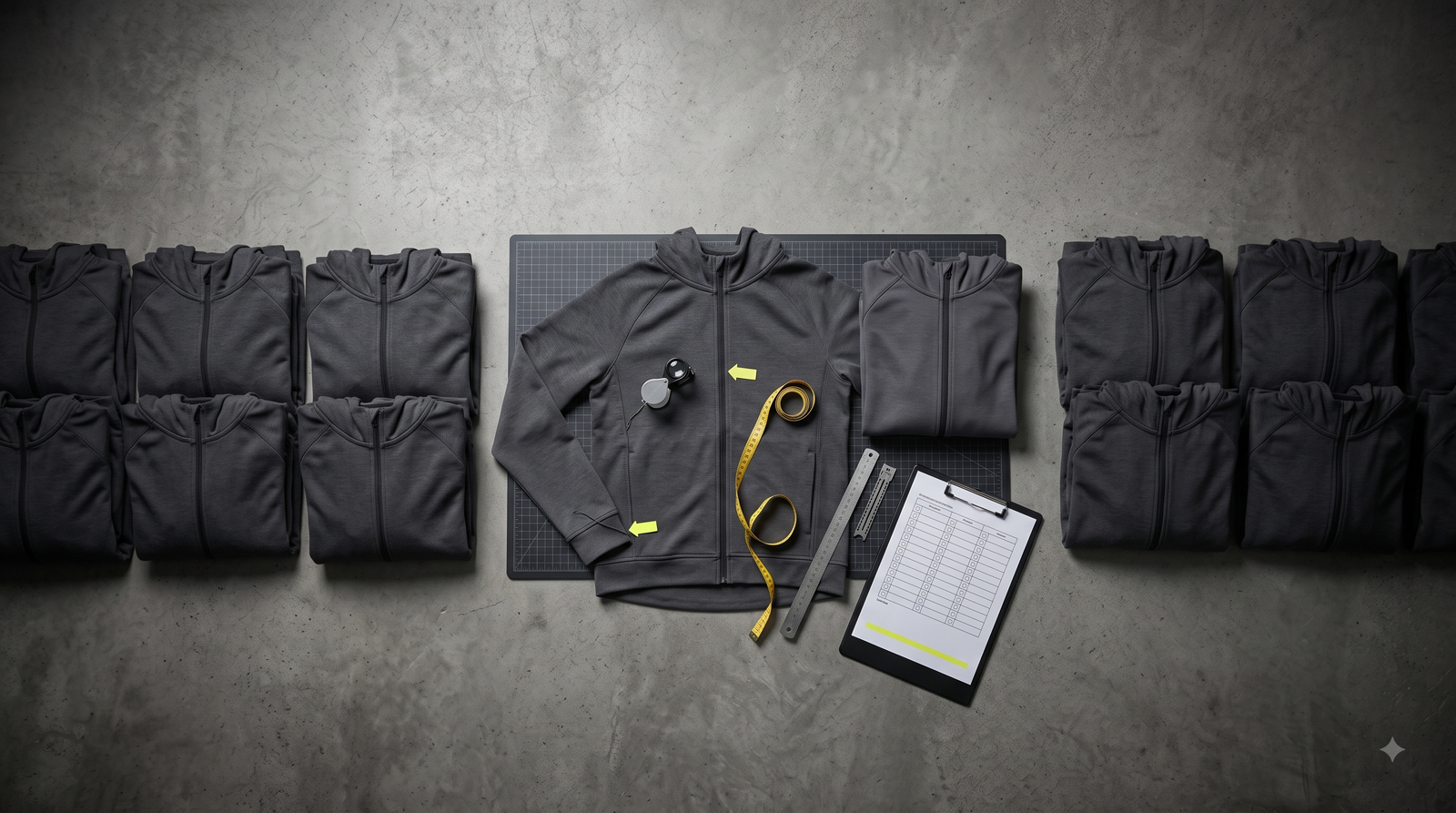
Approved materials, pattern and measurement control, in-process checks, finishing, packing and final inspection all sit inside QC.
AQL is a lot decision
A random sample is checked and the observed nonconformities are compared with the acceptance and rejection numbers in the agreed sampling plan.
A factory can inspect every finished garment without calling that inspection “AQL”. It can also run an AQL sample and still have weak process control. Strong quality assurance uses an approved standard throughout production, then chooses a sensible final inspection method for the order size and risk.
What AQL actually means
The current international reference is ISO 2859-1:2026, a system of acceptance sampling plans for lot-by-lot inspection by attributes. In the United States, buyers may also specify ANSI/ASQ Z1.4. Both systems connect the lot size, inspection level and selected AQL to a sample size and an acceptance/rejection rule.
AQL 2.5 does not mean “2.5% defective garments are allowed in this shipment.” The AQL is an index used to select a sampling plan. The actual decision comes from the number and type of nonconformities found in the random sample, compared with that plan’s acceptance and rejection numbers. Sampling also carries statistical risk: a good lot can be rejected and a poor lot can be accepted, which is why AQL never replaces prevention and process control.
How an AQL inspection plan is set
- Define the lot: the quantity and styles or colours covered by the inspection.
- Select the inspection level: this controls how large the sample will be. General Inspection Level II is often used as a starting point in third-party briefs, but it is not automatic.
- Agree the defect classes: critical, major and minor must be defined for the actual product.
- Assign the limits: the purchase order or inspection brief states the agreed AQL for each class. A brief might specify zero tolerance for critical issues and AQL 2.5 / 4.0 for major / minor issues, but that is an example — not a universal garment rule or a Lesstell default.
- Use the standard table: the lot size, level and AQL produce the sample size and exact accept/reject numbers. These numbers should come from the named standard, not be guessed.
Critical, major and minor garment defects
There is no universal list that classifies every apparel defect the same way. The buyer and manufacturer should agree the classification using the product’s intended use, price point and legal requirements.
Critical
A safety or legal problem: an exposed sharp object, prohibited contamination, or a required safety warning missing. Critical issues are commonly treated as zero tolerance.
Major
A defect likely to make the garment unsellable or returned: measurements outside tolerance, an open seam, broken zip, wrong fabric or colour, or badly misplaced decoration.
Minor
A smaller workmanship or cosmetic issue that does not normally stop use or sale, such as a removable loose thread or slight stitch inconsistency in a low-visibility area.
Context matters. A small shade difference may be minor on a washed vintage garment but major on a matching set. A loose thread may be minor; an unsecured seam in the same area may be major. Photos and product-specific examples make the inspection brief far more reliable than labels alone.
The garment QC checkpoints that prevent problems
- Before production: approve the fabric, colour, trims, artwork, measurement chart and construction details in the tech pack and physical sample. Where pilling performance is part of the agreed specification, review the fabric pilling test reports alongside the material approval.
- During production: check early units for measurements, seam construction, decoration placement and repeatability before the same mistake spreads across the lot.
- Finishing: inspect thread trimming, pressing, stains, labels, size assortment and packaging.
- Before shipment: compare finished garments with the approved PP sample and written tolerances, verify quantities and packing, then apply the agreed full-inspection or sampling plan.
The approved PP sample is the physical reference. The tech pack is the written reference. QC becomes subjective when either one is missing.
What a clothing brand should put in writing
Before approving bulk, document these points in the purchase order, quality manual or inspection brief:
- approved PP sample and dated tech-pack revision;
- measurement tolerances and which points of measure are critical;
- fabric, colour, artwork, trim and packaging standards;
- product-specific critical, major and minor defect examples;
- the exact sampling standard and edition, inspection level and AQL values if sampling is required;
- what happens after failure — hold, sort, rework, replace and reinspect before release.
If an inspection fails, the shipment should not simply move forward with a discount. The affected lot is held, the cause is identified, defective units are separated or reworked, and the agreed reinspection is completed before release. Once released, use the approved packing data and named destination to compare DDP, FOB, FCA and air versus sea shipping before the cartons move.
Does a 50-piece order need AQL sampling?
Not always. On a low-MOQ order, the sample required by an acceptance plan can represent a large share of the lot, so a piece-by-piece appearance and workmanship check may be more practical. Higher-risk features — measurements, zips, snaps, decoration or regulated components — can still receive focused checks. The right plan depends on quantity, product risk and the brand’s requirements, and should be agreed before production starts.
Build quality into the orderFor a Lesstell order, the approved sample and agreed specification are the reference for bulk QC. If your brand requires a formal AQL inspection, define the standard, inspection level and defect limits with us before production so the final decision is objective. See our OEM/ODM clothing manufacturer process or start with our custom clothing manufacturer team.
Garment QC & AQL FAQ
What does AQL 2.5 mean?
It is an index used with a named sampling standard to select a sample size and acceptance/rejection rule. It does not mean that exactly 2.5% defective garments are automatically acceptable in the shipment.
Is AQL the same as quality control?
No. QC is the complete system used to prevent and detect problems. AQL is one method for making an accept/reject decision on a lot using a random sample.
What are critical, major and minor defects?
Critical defects create a safety or legal risk; major defects are likely to make a garment unsellable or returned; minor defects are smaller cosmetic or workmanship issues. The exact classification should be agreed for the product.
Which AQL level should a clothing brand use?
There is no single legal default for all garments. The brand should define the sampling standard, inspection level and defect limits based on product risk, quantity and customer requirements before production.
What happens if an AQL inspection fails?
The lot should be held while the cause is investigated. Affected units are sorted, reworked or replaced, then the lot is reinspected under the agreed rule before shipment is released.