
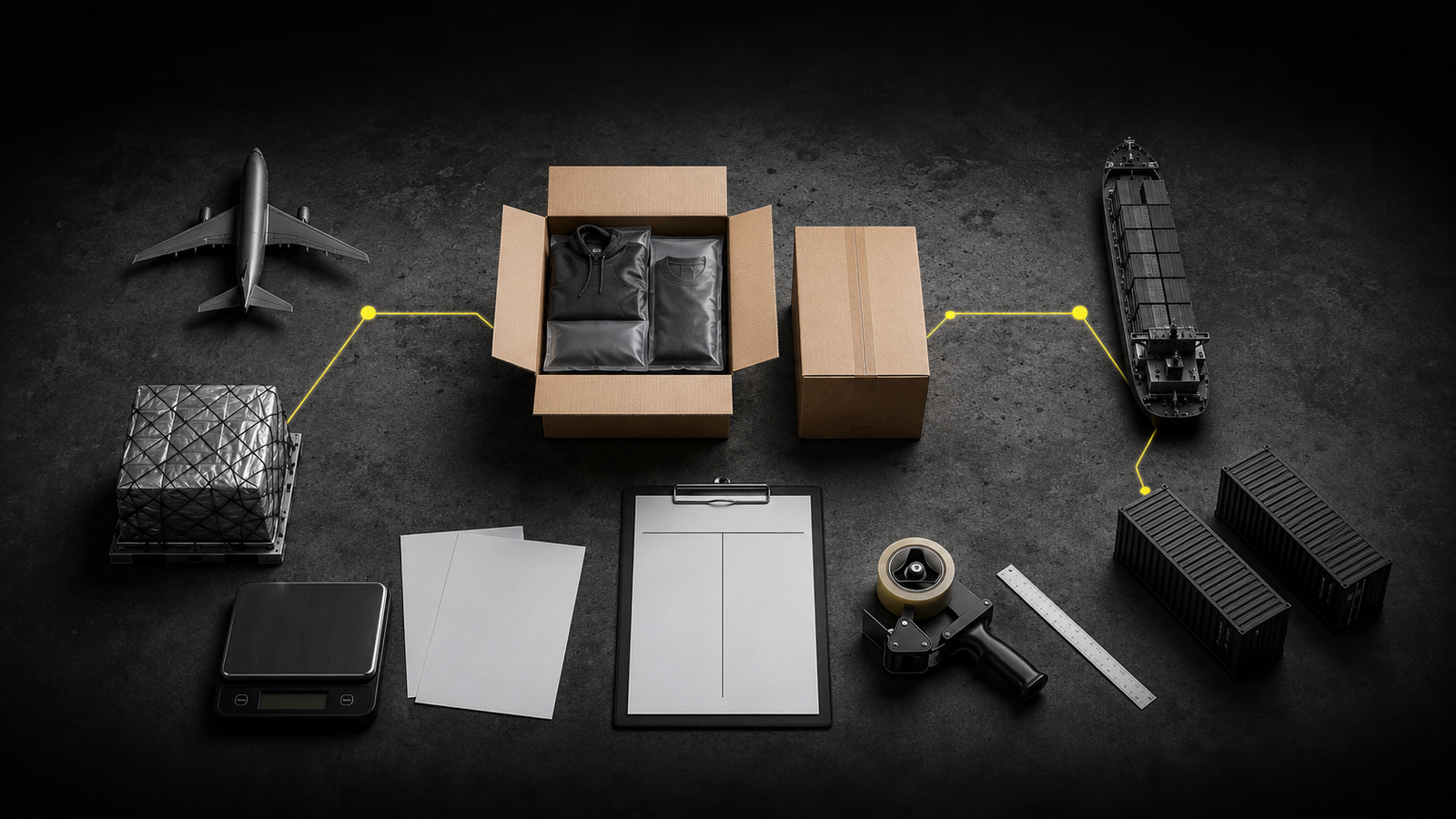
“Should we ship DDP or FOB — and is air or sea better?” sounds like one question, but it is actually two. DDP, FOB and FCA divide delivery tasks, costs and risk between seller and buyer. Air, courier and sea describe how the cartons physically move. Choosing the transport mode without defining the trade term can leave a clothing brand with unexpected customs, destination or delivery charges.
DDP can be used with air, sea, courier or multimodal transport: the seller arranges carriage, clears the goods for import and bears risk until they reach the precisely named destination, ready for unloading. FOB is only for sea or inland-waterway shipments: the seller delivers on board the buyer-nominated vessel at the named port of shipment, and risk transfers there. For air freight and most containerised apparel handed to a carrier before vessel loading, FCA is usually the more accurate rule to consider. Air versus sea is a separate decision based on packed weight and volume, launch urgency, order size and total landed cost.
Two decisions: the trade term and the transport mode
Decision 1: who controls each stage?
The Incoterms® rule identifies the delivery point, when transit risk moves from seller to buyer, who arranges carriage and which party handles export and import formalities.
Decision 2: how should the order move?
Courier, air freight and sea freight are transport services. The best option depends on the packed shipment, route, launch plan and complete door-to-door quote.
A shipment can therefore be DDP by air, DDP by sea or FCA for an air or container movement. “FOB air freight” is not a correct use of the ICC rule because FOB requires delivery on board a vessel.
DDP vs FOB vs FCA for clothing orders
DDP — Delivered Duty Paid
Any mode. The seller arranges carriage to the named destination, completes export and import clearance and bears the risk to that point. The goods are delivered on the arriving vehicle, ready for unloading. The buyer normally takes delivery and unloads unless the contract or carriage arrangement says otherwise.
FOB — Free On Board
Sea or inland waterway only. The buyer nominates the vessel and controls the main ocean carriage. The seller completes export clearance and delivers the goods on board at the named port of shipment. Risk transfers when the goods are on board.
FCA — Free Carrier
Any mode. The seller completes export clearance and delivers the goods to the buyer's nominated carrier at the precise named place. Risk transfers at that delivery point. FCA commonly fits air freight and container shipments handed to a carrier or terminal before vessel loading.
What none of them decides
An Incoterms® rule does not set the product price, payment terms, ownership transfer, tariff rate, delivery deadline, product compliance or remedies for delay. Those points still need to be written into the sales contract.
What DDP really includes — and what to confirm
DDP gives the seller the highest level of responsibility among the eleven Incoterms® 2020 rules. The seller carries the transport risk to the named destination and is responsible for the required export, transit and import clearance, including applicable import duties and taxes under the rule.
That does not make every DDP quote identical. A useful contract names the exact delivery point — not only a country or city — and confirms:
- the full delivery address and whether it has a loading dock, restricted access or an appointment requirement;
- who can legally act as importer of record or complete import clearance in the destination country;
- the agreed product classification, declared value and country-of-origin documents;
- that the quoted price includes the brokerage, applicable duties and taxes, destination handling and final delivery allocated to the seller under DDP, with any expressly agreed exception identified;
- who pays exceptional inspection, storage, demurrage, redelivery or address-correction costs if they occur;
- whether unloading is included in the carriage contract or remains the buyer's task;
- whether cargo insurance has been arranged, its scope and how a claim would be handled.
DDP itself does not require the seller to buy insurance for the buyer. It also cannot override local importer, customs or tax rules. If the seller cannot lawfully complete import clearance, the parties should consider DAP or another suitable arrangement with professional customs advice.
Why “FOB air freight” is the wrong term
FOB means the goods are delivered on board a vessel at a named port of shipment. It is therefore not available for an airport handover, courier pickup or air-cargo terminal.
If a clothing brand appoints its own forwarder for an air shipment, FCA at the seller's premises, forwarder's warehouse or another precisely named place is usually the relevant rule to examine. The exact FCA delivery point matters because it determines where the seller's delivery is complete and where risk transfers.
The same issue appears with containerised apparel. A factory often hands a sealed carton or container to a carrier or terminal before the goods are loaded onto a vessel. ICC guidance advises considering FCA in that situation because the FOB risk-transfer point occurs later, when the goods are actually on board. FOB can still be used when the parties intentionally require true on-board delivery, but it should not be chosen merely because the shipment will eventually travel by sea.
Air vs sea freight for apparel
Air freight or express
Consider it for: samples, smaller urgent orders, launch-critical replenishment or lighter shipments where time matters more than the lowest freight cost.
Check: actual and volumetric weight, carton dimensions, airline or courier limits, customs service, final delivery and the complete landed quote.
Sea freight
Consider it for: larger or heavier orders with enough planning time, especially when freight cost per unit matters more than speed.
Check: LCL versus FCL, origin and destination charges, consolidation, port and customs handling, final delivery and schedule variability.
Sea freight is not automatically the lowest-cost answer for every small order. LCL shipments can carry minimum, documentation, consolidation and destination fees. Air is not priced only by scale weight either: carriers may charge by the greater of actual or volumetric weight, so bulky lightweight garments can cost more than expected. Compare the same destination and the same included services, not two headline freight numbers.
Shipping scenarios for clothing brands
Samples and PP samples
A prototype or approved PP sample is normally a small, time-sensitive shipment, so express courier or air is often the practical route. FOB does not apply. Confirm whether the courier quote is DDP, DAP or another arrangement and who will handle any import charge or clearance request.
A small-batch first drop
For a low-MOQ order, request both an air and a consolidated-sea quote using the final carton count, packed weight and dimensions. Air may protect a close launch date; sea may improve unit economics when the order is sufficiently large and the schedule allows it. DDP may simplify receipt where the seller and logistics provider can complete import clearance legally. FCA can suit a brand that already has a trusted forwarder and importer setup. If the production quantity is not decided yet, first compare the inventory and cash trade-offs in our small-batch vs bulk production guide.
A larger bulk order
Sea freight becomes more likely as weight and volume increase, but the Incoterms® rule still depends on who should control the logistics. FCA is often clearer for containerised cargo transferred to a carrier before loading. DDP can support door-to-door delivery when the import arrangement is workable and precisely documented. FOB is appropriate only when the parties deliberately choose an on-board-vessel delivery point.
A split shipment before launch
A brand can sometimes move a limited launch quantity by air and the balance by sea. Treat them as two clearly documented shipments, with separate carton lists, transport services, delivery terms and cost assumptions. Splitting freight can protect a launch without paying air rates for the entire order, but extra handling and minimum charges must be included in the comparison.
Compare landed cost, not freight alone
Your practical landed-cost calculation is:
garment value + packaging + origin handling + main freight + insurance + destination handling + customs brokerage + duties and taxes + final delivery + any foreseeable storage or access costs
The Incoterms® rule allocates which party arranges and initially pays these stages; it does not make the costs disappear. A lower factory-to-port freight line can become the more expensive choice after destination charges and local delivery are added. Include shipping in your wider clothing-line cost plan before approving bulk production.
What to send for a comparable shipping quote
- Final product and quantity: styles, units, carton count and whether the order can be split.
- Packed data: gross weight, carton dimensions and total cubic volume based on the final pack plan.
- Origin and destination: exact pickup and delivery points, including postcode and access conditions.
- Named rule: for example, “DDP [precise address], Incoterms® 2020”, “FOB [named port of shipment], Incoterms® 2020” or “FCA [precise warehouse], Incoterms® 2020”.
- Transport service: express, airport-to-airport, door-to-door air, LCL, FCL or another defined service.
- Included charges: origin, main carriage, surcharges, destination handling, brokerage, duties, taxes and final delivery.
- Import arrangement: importer of record, customs broker, product classification and supporting documents.
- Insurance: insured value, exclusions, deductible and claim procedure.
- Schedule assumptions: cargo-ready date, estimated departure and arrival windows, cutoff dates and quote validity.
- Exceptions: possible inspection, storage, redelivery, remote-area, demurrage or detention costs.
Freight rates and schedules change. Use an estimate for early planning, then obtain a refreshed quote using the approved packing data before the goods are released. The final packing list should also be checked against the order after the agreed pre-shipment quality inspection.
Plan production and delivery together
Shipping should be planned before bulk is finished, not after the cartons are sealed. Use our clothing production lead-time guide to work backwards from the required stock-in date through production, QC, freight and customs. Lesstell can coordinate production, packing information and delivery options around your order and launch plan, while the final Incoterms® rule and import arrangement are confirmed for the destination. Explore our full-package clothing manufacturing workflow or our OEM/ODM clothing manufacturing program.
DDP, FOB and apparel shipping FAQ
What is the main difference between DDP and FOB?
Under DDP, the seller bears cost and risk to the named destination and completes export and import clearance, including applicable import duties and taxes. Under FOB, the seller clears the goods for export and loads them on the buyer-nominated vessel at the named port of shipment; the buyer controls the main sea carriage and risk transfers on board.
Can FOB be used for air freight?
No. Under Incoterms® 2020, FOB is only for sea or inland-waterway transport and requires delivery on board a vessel. An air shipment collected by the buyer's carrier will usually require consideration of FCA or another rule suitable for any transport mode.
Should containerised apparel ship FCA or FOB?
When the seller hands the container or goods to a carrier or terminal before vessel loading, ICC guidance says the parties should consider FCA. FOB fits only when delivery is intended to occur after the goods are placed on board the nominated vessel.
Does DDP include duties, taxes, insurance and unloading?
DDP assigns export and import clearance and applicable import duties and taxes to the seller. It does not require the seller to arrange insurance for the buyer. Delivery occurs on the arriving means of transport ready for unloading, so unloading is normally the buyer's responsibility unless the contract or carriage arrangement includes it.
Should a small clothing order go by air or sea?
There is no fixed answer. Compare both modes using final packed weight, carton dimensions, destination, launch deadline and all origin, destination, customs and delivery charges. Air often suits urgent or compact orders; consolidated sea may work when the shipment is large enough and the schedule allows it.