Clothing production lead time is not one factory number. It is the combined time for design clarification, costing, material confirmation, sample rounds, bulk production, quality control, packing and transport. A launch can be delayed even when sewing is on schedule if fabric is late, feedback is slow or the delivery plan was left until the cartons were ready.
For a new custom style, a sensible early planning allowance is often about 6–12+ weeks from a production-ready brief to packed goods, before international transit. A simple repeat order using confirmed materials can be faster; custom knitting or dyeing, complex decoration, multiple sample rounds and peak-season capacity can make it longer. Treat every range below as a planning window, then replace it with a project-specific calendar after the specification, materials, quantity and destination are confirmed.
Production lead time and shipping time are different
Production lead time normally runs from an agreed starting point — such as receipt of a complete tech pack, deposit and confirmed material direction — until inspected, packed goods are ready for release. Transit time begins after handover to the courier, airline, forwarder or ocean carrier. A quoted launch date should include both, plus a buffer for approvals and events outside the factory's control.
Define the starting and finishing points in writing. “Four weeks” can mean four weeks after the first inquiry, after sample approval, after fabric arrives or after the deposit clears. Those are four different calendars.
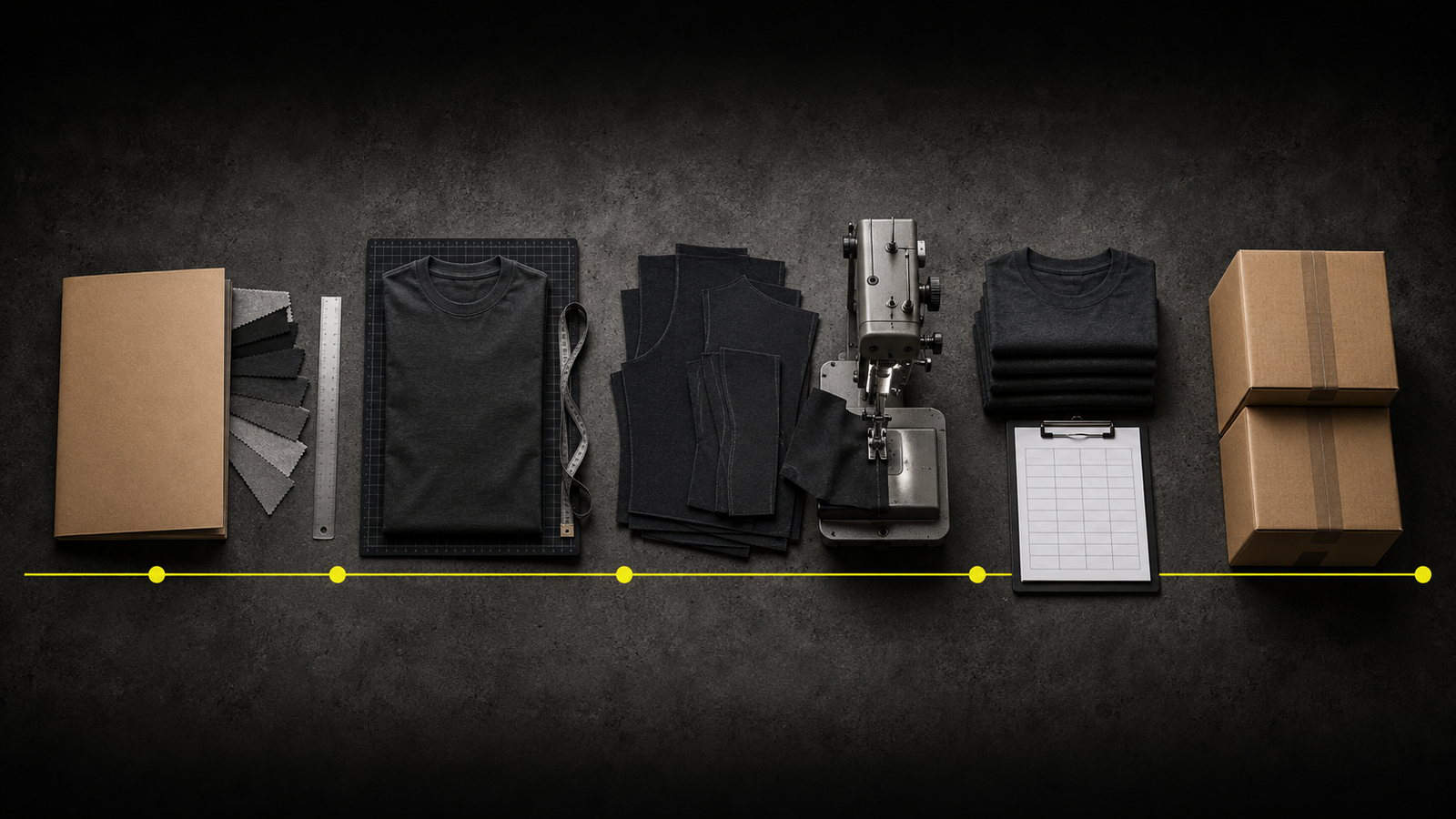
A practical clothing production timeline
The ranges below are useful for early planning, not a guaranteed schedule. Some stages can overlap; others cannot start until a specific approval is complete.
1. Brief, review & costing
Planning range: 2–5 business days. The factory reviews the tech pack or reference, confirms missing details, checks material and process feasibility and prepares a comparable quotation.
2. Proto or fit sample
Planning range: 1–3+ weeks per physical round. Pattern complexity, material availability, decoration and the speed of consolidated feedback determine how many rounds are needed.
3. PP sample & approval
Planning range: 1–3+ weeks after final materials are available. The pre-production sample confirms the actual fabric, trims, construction, colour and decoration before bulk cutting.
4. Fabric & trims
Planning range: days to several weeks. Stock-supported fabric and standard trims can move quickly. Custom knitting, dyeing, washing, hardware or packaging may become the critical path.
5. Bulk production
Planning range: 1–4+ weeks after approvals. Quantity, garment complexity, decoration, wash processes, line capacity and required rework all affect the calendar.
6. QC, packing & release
Planning range: 2–5+ business days. Final measurement and workmanship checks, any agreed AQL inspection, correction, packing-list confirmation and carton preparation happen before release.
International transit is then added separately. Express or air commonly works in days rather than weeks, while sea freight normally requires a multi-week allowance; the route, service level, capacity, customs and final delivery point decide the real window. Compare the current options using our DDP, FOB, FCA and air-versus-sea shipping guide.
Stage 1: a complete brief starts the clock properly
A manufacturer cannot schedule an undefined garment. The fastest projects begin with a usable clothing tech pack or a reference sample plus a written change list. At minimum, confirm the style, base measurements, size range, fabric composition and GSM, colourways, construction, decoration, labels, packaging, quantity and destination.
Incomplete information does not remove time from the project — it moves that time into repeated questions, revised quotes and sample corrections. The first practical milestone should therefore be specification ready for costing, not “first message sent.”
Stage 2: sample rounds are a decision loop
A proto or fit sample tests whether the pattern, proportion and construction work. A revision creates another loop: sample, measure, try on, comment, correct and remake. Complex silhouettes, new blocks or unclear feedback require more loops than a simple repeat style.
Brands shorten this stage by returning one consolidated, measurable comment sheet instead of separate messages. “Increase body length by 2 cm in the base size” can be actioned; “make it feel more premium” cannot. If several people approve the product, agree internally before sending comments to the factory.
Stage 3: the PP sample is the production gate
The pre-production sample should represent the intended bulk fabric, trims, decoration and construction. Once approved, it becomes the physical reference used alongside the written specification. Read our PP sample approval guide for the exact checks.
Do not recover a late calendar by approving an unresolved PP sample. A rushed approval can move the problem into every unit, where correction costs more and takes longer. Record final comments in writing and state whether the sample is approved, rejected or approved only after named corrections.
Stage 4: materials often control the critical path
Fabric and trims can be ordered during development when the risk is understood, but final bulk commitments normally depend on confirmed colour, composition, GSM, quantity and performance. Stock-supported materials are easier to schedule at low volume. Custom-dyed, custom-knitted or specially washed fabric may require lab dips, strike-offs, supplier minimums and additional testing.
Hardware, rib, drawcords, labels, packaging and decoration consumables also need approval. One late custom zip or woven label can hold an otherwise finished garment, so the bill of materials should assign an owner and approval date to every component.
Stage 5: bulk is more than sewing
Bulk production can include fabric relaxation, spreading, cutting, bundling, sewing, decoration, washing, finishing, pressing and in-line inspection. A basic T-shirt and a lined jacket with custom hardware do not use the same number of operations, even at the same quantity.
Review the complete sequence in how clothing manufacturing works from tech pack to bulk. Ask which operation is expected to be the constraint and whether embroidery, printing, washing or an outside material process sits on the critical path.
Stage 6: QC and packing need calendar space
Inspection should not be treated as a ceremonial final hour. Bulk is checked against the approved sample, tech pack, measurement tolerances, workmanship criteria and agreed defect rules. If inspection identifies a problem, the affected units may need separation, correction and reinspection before release.
Define the checkpoints and lot decision before production using our garment quality control and AQL inspection guide. Then allow time for folding, labels, polybags or alternative packaging, carton marks, carton count, gross weight, dimensions and the final packing list.
The eight delays brands can control
- Changing the specification after sampling: a new fabric, colour, fit or decoration can restart costing and approval.
- Slow or fragmented feedback: every approval loop waits for one clear brand decision.
- Too many first-drop variables: extra styles, colours and custom trims create more dependencies.
- Late artwork: production files, placement and size should be approved before decoration setup.
- Unconfirmed size breakdown: fabric use, labels and packing cannot be finalised without quantities by size and colour.
- Ignoring supplier minimums: low garment MOQ does not automatically remove fabric, dyeing or trim minimums.
- Booking freight too late: packed data and importer arrangements should be planned before production finishes.
- No launch buffer: a calendar that assumes every sample, carrier and customs event occurs at the earliest possible date is not a reliable plan.
How to shorten lead time without skipping control
- Freeze the critical specification: approve the product direction, base measurements, materials and decoration before the formal schedule starts.
- Use one decision owner: give the factory one consolidated set of comments for each round.
- Choose achievable materials: use stock-supported options when the launch date matters more than a custom colour or knit.
- Approve components in parallel: review labels, packaging and artwork while the physical sample is progressing where practical.
- Keep the first collection focused: fewer hero styles and colourways reduce dependencies and cash exposure.
- Plan inspection and freight early: agree QC scope, destination, Incoterms® rule and transport options before the cargo-ready date.
- Preserve approved data for repeats: a stable tech pack, pattern, BOM and approved sample can make a reorder more predictable than a new style.
Work backwards from the launch date
Start with the date stock must be available for fulfilment — not the campaign date — then work backwards through receiving, customs and final delivery, international transit, freight booking, QC and packing, bulk production, material arrival, PP approval and earlier sample rounds. Add decision deadlines for the brand at every approval point.
A useful calendar has three dates for each milestone: target, latest safe approval and contingency action. For example, if a custom dye misses its latest safe date, the contingency may be an approved stock colour rather than pretending the launch date has not moved.
What to send for a project-specific timeline
- tech pack or reference garment with a complete change list;
- styles, colourways, size range and quantity by style;
- fabric composition, GSM, finish and whether custom development is required;
- print, embroidery, applique, wash and other special processes;
- labels, packaging and compliance requirements;
- delivery postcode, target stock-in date and preferred transport options;
- dates when your team can review samples and return consolidated feedback.
With those inputs, the manufacturer can identify dependencies and issue a calendar that is specific enough to manage — rather than a generic number that hides the real critical path.
Plan development, production and delivery as one projectLesstell coordinates custom apparel development from specification and sampling through bulk, QC, packing data and delivery planning. Timing is confirmed against the actual product, materials, quantity and destination. Explore our full-package clothing manufacturing workflow or our OEM/ODM clothing manufacturing program to build a project-specific timeline.
Clothing production lead time FAQ
How long does clothing manufacturing take?
For a new custom style, an early planning allowance is often about 6–12 weeks or more from a production-ready brief to packed goods, before international transit. Simple repeats can be faster, while custom materials, complex garments and additional sample rounds can extend the schedule. The factory should replace this planning range with a project-specific calendar.
When does clothing production lead time start?
Define it in the quotation or production plan. A practical start point may require a complete specification, confirmed materials and quantity, deposit and all required approvals. “Lead time” is ambiguous unless the start and finish milestones are named.
How long does a clothing sample take?
A physical sample round commonly needs roughly 1–3 weeks or more, depending on pattern complexity, material and trim availability, decoration and factory capacity. Each revision and approval loop adds time, so consolidated, measurable feedback is important.
Does the production timeline include shipping?
Not automatically. Production lead time usually ends when inspected and packed goods are ready for release. Courier, air or sea transit, customs and final delivery should be shown as separate stages unless the quotation explicitly includes them.
What causes the biggest clothing production delays?
The most common causes are incomplete specifications, extra sample rounds, late feedback, custom fabric or trim development, artwork changes, too many colourways, rework after inspection and freight or customs disruption.
Can a manufacturer guarantee a launch date?
A factory can commit to the stages it controls under agreed assumptions, but a reliable plan also identifies brand approvals, supplier dependencies, carrier schedules, customs and contingency time. Ask for milestone dates and responsibilities rather than relying on one unsupported delivery promise.