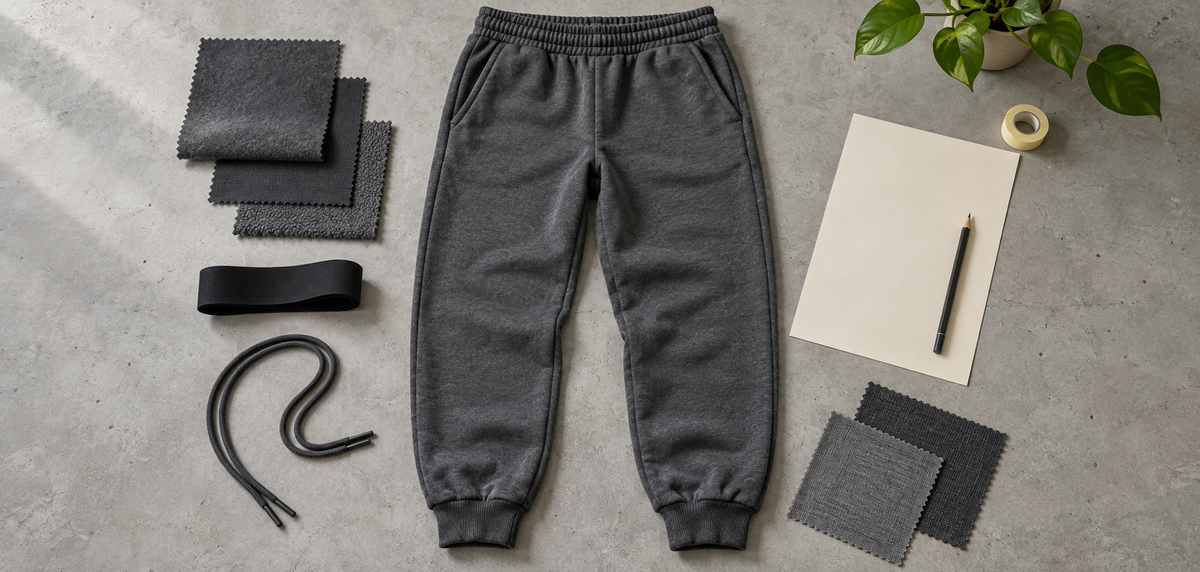
Two custom sweatpants quotations can describe the same color and still cover different garments. One may include brushed fabric, reinforced pocket openings and an embroidered logo; another may assume an unbrushed fabric, simpler pockets and no decoration setup. Comparing only the unit price hides those differences.
Custom sweatpants cost depends on the agreed fabric and finish, garment construction, decoration, order breakdown and quotation scope. For a useful comparison, send each manufacturer the same specification and ask them to identify inclusions, exclusions and assumptions. Separate recurring garment costs from development, setup, testing and delivery charges before choosing a production option.
1. Price the finished fabric, not just the GSM
For an autumn or winter sweatpant, specify fiber composition, knit construction, finished weight, color and the intended inner surface. A description such as “heavy cotton fleece” leaves room for different materials. GSM measures mass per unit area; it does not define the fabric's hand, recovery or quality by itself.
If two quotations use different compositions, compare the cotton and cotton-poly fleece options against the same garment brief before deciding on price.
CottonWorks distinguishes un-napped French terry from fleece with a raised inner surface. Ask suppliers to identify the fabric they are quoting and provide a physical reference for the intended finish. Do not compare a looped-back swatch with a brushed sample as though the GSM makes them equivalent.
Include any garment wash or additional finishing in the request. CottonWorks explains that napping raises surface fibers and compaction changes fabric dimensions. These are separate processing decisions, so ask which are already included in the fabric price. A finishing description is not evidence of an approved wash-test result.
The garment pattern and size mix also matter to material consumption. Ask the manufacturer to quote the actual silhouette and size range, rather than applying a price from a different sweatpant.
2. Identify the construction details that change the quote
Describe the waistband, drawcord, pockets and leg finish before requesting comparable prices. Two sweatpants with similar front views can require different components and assembly steps.
- Waistband: elastic specification, finished depth, attachment, drawcord exits and tips.
- Pockets: number, pocket-bag fabric, opening construction, reinforcement and any closures.
- Leg finish: open hem, rib cuff or enclosed elastic, including the required trim.
- Seams and details: paneling, visible topstitching, labels and any specified reinforcement.
For heavy fabric, ask the sample review to include bulk at the waistband, pocket joins and crotch intersection. A construction change should be reviewed for comfort and appearance before it becomes a cost-saving decision. Our custom joggers manufacturing guide covers the measurements and functional checks behind those specifications.
3. Quote decoration by the approved artwork brief
“One embroidered logo” is incomplete. Send the artwork, finished dimensions, colors, placement and number of decorated locations. A small thigh logo and a long graphic down both legs are different requests, even if they use the same brand mark.
For embroidery, ask whether digitizing and a physical sew-out are included or charged separately. For print, ask about artwork preparation, screens or other setup, and the quoted technique. Confirm whether those charges apply once, per design or to later revisions; do not assume every setup is reusable without a fee.
Placement also needs review. An image close to a pocket opening, seam or cuff may require a different production approach. Approve the intended result on the selected fabric, and have any artwork or placement changes reflected in the updated quotation.
4. Give quantities by style, color and size
A total order quantity does not describe the production breakdown. Provide a quantity matrix for each style and color, with units by size. Ask which material, trim or decoration minimums apply to that exact plan and whether any size-related pricing is included.
Request alternative quantity quotations against the same specification. A larger order may distribute some setup costs across more pieces, but that does not establish a fixed discount or make unwanted inventory worthwhile. Compare the total commitment as well as the quoted unit price.
5. Separate garment price from project charges
Use the following checklist to identify what a quotation includes. A separately listed charge is not automatically an extra: check whether another supplier has already included it in the garment price.
| Quote item | Confirm in writing | Comparison risk |
|---|---|---|
| Finished garment | Fabric, trims, sewing, decoration and finish included per piece. | A lower price may assume fewer features. |
| Development | Pattern work, physical samples, revisions and grading scope. | Different numbers of samples or revisions. |
| Decoration setup | Artwork preparation, digitizing, screens and approval samples. | Setup is omitted or counted twice. |
| Testing and inspection | Required checks, sample coverage and any outside-provider fees. | Different review or testing scopes. |
| Packing | Labels, tags, individual bags, assortment and cartons. | Retail packing is assumed but excluded. |
| Delivery | Named destination, transport, agreed trade term and excluded charges. | Factory price is compared with delivered cost. |
If a sample fee can be credited against a bulk order, record the conditions, amount and point at which the credit applies. Treat it as a conditional credit, not an automatic cash refund. Also confirm currency, quote validity and payment milestones.
6. Check packaging and freight on the same basis
Specify whether sweatpants are packed individually or as part of a matching set, and whether cartons need a particular size assortment. Ask the supplier to distinguish estimated packing data from final carton weights and dimensions.
A garment price without delivery cannot be compared directly with a delivered quotation. Record the agreed trade term and named place, the transport mode, and responsibility for customs-related charges. Our DDP vs FOB clothing shipping guide explains those distinctions. Obtain an updated freight quotation when the final shipment details are available.
7. Change one specification at a time
If the quote exceeds your budget, identify which decisions are flexible. Ask for one clearly labeled alternative at a time: a different approved fabric, a simpler pocket construction, another drawcord finish or a revised decoration size. Keep the remaining specification and order breakdown unchanged so the comparison is useful.
Record both the price change and the product change. A revised quotation should identify its specification version, remaining assumptions and required sample approval. Use a current clothing tech pack to keep those decisions together. If the drop includes a hoodie, compare its separate cost drivers using our custom hoodie quotation guide.
Request a sweatpants quotation
Send your design, fabric reference, construction details, artwork, quantities by color and size, packing requirements and delivery destination to Lesstell's custom joggers and sweatpants manufacturing team. Mark unresolved details clearly so the quotation can separate confirmed specifications from options requiring development.
Frequently asked questions
How much does custom sweatpants manufacturing cost?
There is no useful single price without a defined product and order. Request a quotation for your fabric, construction, decoration and quantity breakdown, then confirm development, packing and delivery inclusions.
Does a higher GSM always mean a more expensive sweatpant?
GSM alone cannot establish the finished garment price. Compare the actual fabric construction, composition, finish, pattern and quantities, together with the rest of the specification.
Does ordering more always reduce the unit price?
No fixed reduction should be assumed. Request comparable quantity options and check how material requirements, color splits and setup charges affect each quotation. Include the total inventory commitment in the decision.
Are embroidery and printing setup fees included?
That depends on the quotation. Ask suppliers to identify artwork preparation, digitizing, screens and approval samples separately, including when revisions or repeat orders would create another charge.
Can a sweatpants sample fee be credited toward bulk production?
Ask for the applicable written terms. Confirm which bulk order qualifies, what credit is available and when it is applied; a credit against production is different from a cash refund.
What should I check when one quote is much lower?
Compare specifications, order breakdown, included development, decoration, packing and delivery before drawing conclusions. Ask the supplier to explain differences and exceptions; the price alone does not prove equivalent scope or product quality.