
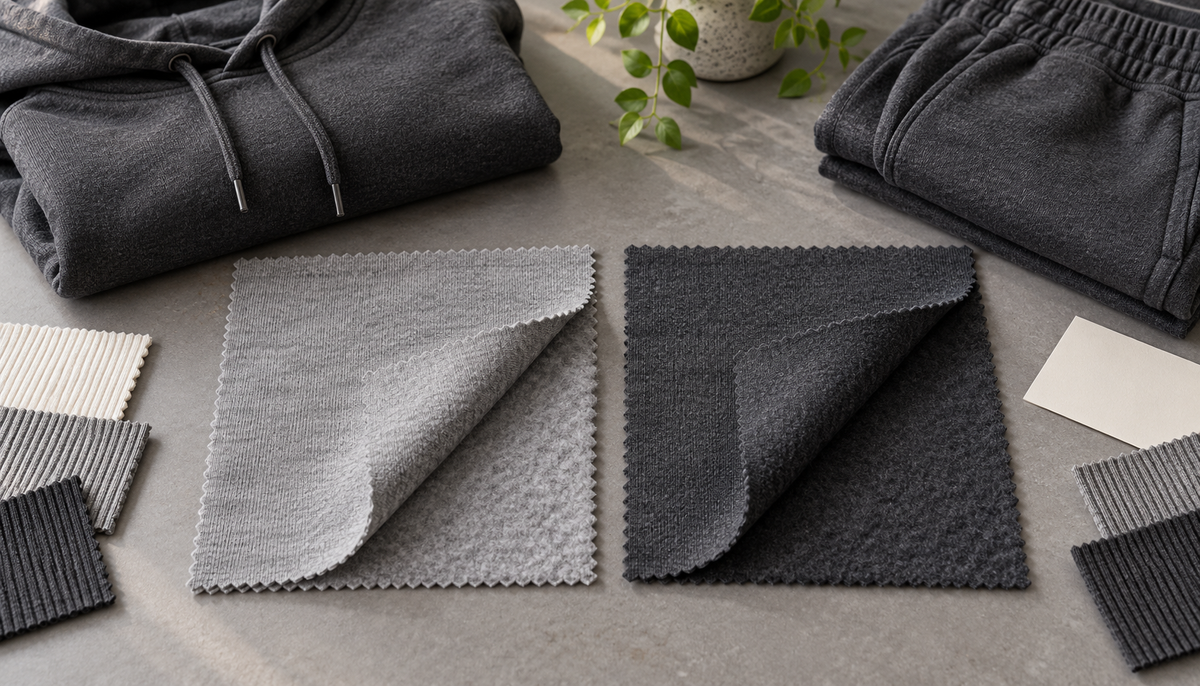
100% cotton fleece uses cotton throughout the specified fabric; cotton-poly fleece combines cotton and polyester. Neither description alone tells a clothing brand how the finished hoodie or sweatpant will feel, wash or decorate. Compare actual fabric candidates with their construction, finished weight, surface treatment and care conditions identified, then approve the material on a physical garment sample.
For a winter collection, the useful question is which fleece delivers your intended garment, not which fiber name wins in every situation. A cotton option and a blended option can differ in much more than composition. Separate those variables before comparing prices or approving a replacement.
Start with the whole fabric, then ask about its face
A supplier's description of a “cotton face” refers to the outer surface. It does not necessarily describe the entire fabric. Ask for the overall composition and, where relevant, the yarn allocation across the face, connecting yarn and brushed back. Keep the rib specification separate from the body fabric.
CottonWorks' fleece construction overview explains that three-end fleece uses distinct face, tie-in and pile yarns. That construction detail is why a face description and an overall composition answer different questions. A photograph or soft handfeel cannot verify either one.
Record the mill's fabric reference and the composition supplied for that reference. If an all-cotton body is a product requirement, make it explicit; do not accept “cotton-rich” as equivalent. Confirm hood lining, pocketing and rib individually instead of extending the body description to every garment component.
When each option makes sense
Start with 100% cotton when an all-cotton body is part of your product brief. It also keeps body-fabric dyeing focused on one fiber type. Cotton and polyester need different dye chemistry: CottonWorks' dyeing explanation distinguishes reactive dyeing of cotton from disperse dyeing of polyester. A blend needs a color route that accounts for both components and the intended effect.
Include cotton-poly candidates when you want to adjust moisture absorption while retaining cotton in the material. Cotton readily absorbs moisture; polyester has a much lower absorption capacity. The polyester portion therefore offers a different fiber-level starting point. However, absorption is only one part of moisture handling: CottonWorks' moisture-management overview also shows how construction and treatment alter the outcome. Confirm drying or comfort requirements on the finished candidate rather than assigning them from its ratio.
100% cotton vs cotton-poly fleece: a buyer comparison
This table helps organize two candidate fabrics. It is a purchasing checklist, not a set of test results or a claim that every material in either column behaves the same way.
| Decision | 100% cotton option | Cotton-poly option | Approval evidence |
|---|---|---|---|
| Composition brief | Fits a requirement for an all-cotton body fabric. | Includes polyester; a cotton face may still be possible, subject to the yarn specification. | Full composition and face/back yarn details. |
| Moisture absorption | Cotton fibers readily absorb moisture. | The polyester component has much lower fiber absorption. | Finished-fabric evidence for any drying or moisture-handling requirement. |
| Wash behavior | Agree dimensional and appearance requirements. | Apply the same requirements; a blend is not a no-shrink guarantee. | Identified samples evaluated under comparable conditions. |
| Surface appearance | Check face and brushed back where relevant. | Check both surfaces rather than assuming improved pilling resistance. | Appropriate pilling evidence and appearance review. |
| Dyeing direction | Choose a route compatible with cotton and the intended effect. | Account for two fiber types; a cotton dye route alone does not color polyester equivalently. | Approved color trial on the actual fabric and finish. |
| Commercial choice | Quote the confirmed material and processing route. | Quote its own confirmed material and processing route. | Matched order quantities, inclusions and sample references. |
Compare handfeel, body and rib as a garment
Start with candidates close to your target construction and finished weight. Identify any remaining differences in yarn, brushing or finish so you know what the comparison can establish. If both composition and construction change, the result compares two complete materials; it does not isolate the effect of adding polyester.
Handle the face and back separately. Fold the swatches, observe how they hang, and describe the result in usable terms: compact or lofty, fluid or structured, smooth or visibly textured. Keep an approved physical reference instead of relying only on the word “premium.”
Review the chosen fabric in a hoodie hood, pocket opening and sweatpant leg. Check cuff and hem rib for appearance, recovery and compatibility after the agreed wash procedure. For a matching set, compare the hoodie and pants together in the same lighting, including any separate fabric lots. Do not approve the entire set from one small body swatch.
Confirm color and decoration on the selected fleece
Give the supplier your intended color and processing route, including any garment wash or garment dye effect. Ask whether the proposed fabric, rib and decoration can achieve that combination. Do not assume a recipe or approval for one composition transfers unchanged to the other.
For printing, review a strike-off using the actual face, color, finish and artwork. Ask the decorator to confirm the proposed ink or transfer system and its processing requirements. For embroidery, review a sew-out with the intended backing and assess puckering, outline clarity and the feel against the body. Check the decorated garment again after the agreed laundering sequence.
Keep those approvals attached to the exact material reference. A change to the fabric, finish or decoration process should trigger a review of what needs to be checked again.
Use wash and pilling evidence to decide
Construction and processing influence dimensional change as well as fiber content. A blend percentage alone cannot set a reliable shrinkage allowance for your hoodie or sweatpant.
Agree the procedure, cycle count and measurement points before comparing candidates. Check garment length and width separately, along with seams, rib and decoration. Use the garment shrinkage testing guide to organize that evidence. Keep an unwashed reference clearly identified.
Laundering and drying abrasion can alter the surface, including fuzzing and pilling. Neither all-cotton content nor a polyester blend is proof of a satisfactory result. Where pilling performance is specified, review the fabric pilling test method and report conditions, including the tested surface, sample identity and any pretreatment.
Keep test results distinct from subjective handfeel preferences. Choose the material that meets the agreed product requirements, and record any unresolved issues before bulk approval. A result for one sample does not automatically cover every color, finish or future lot.
Send a brief that makes the two quotations comparable
- Product: hoodie, sweatpants or set; silhouette, size range and reference garment.
- Fabric: candidate references, full composition, construction, finished weight and desired face/back appearance.
- Processing: color, brushing, washing and other requested finishes.
- Components: rib, lining, pocketing, decoration and trims.
- Approval: physical sample, intended care, required tests and acceptance criteria.
- Order: quantities by style and color, target timing, packing and delivery scope.
Ask suppliers to identify substitutions and differences in their proposals. Use the sweatpants quotation checklist to separate fabric choices from construction and other charges. Keep the selected reference in the tech pack and physical PP sample approval record.
Frequently asked questions
Is 100% cotton fleece better for hoodies?
It can suit a brief requiring an all-cotton body, but composition is not a complete quality specification. Choose against your intended handfeel, silhouette, decoration, care and verified performance requirements.
Does a cotton face mean the fleece is 100% cotton?
No. Ask for the full fabric composition as well as the face yarn description. A face claim does not establish the composition of the connecting or back yarns.
Does cotton-poly fleece shrink less?
Do not assign a reduction from the blend ratio alone. Compare the identified, finished candidates using the same relevant procedure and review the assembled garment as well as the fabric.
Which fleece is warmer for a winter collection?
Composition alone cannot rank the warmth of two finished garments. Consider the actual construction and garment design; if a thermal performance claim matters, agree appropriate testing rather than inferring it from a blend label.
Which option is better for printing or embroidery?
Review the actual fabric surface, finish, color and artwork with the decorator. Approve a trial and assess the finished garment, including its appearance after the agreed care procedure.
Can the same fleece be used for a hoodie and sweatpants set?
It may be suitable, but review both garments. Confirm how the material, rib, pockets and decoration work in each construction, then assess their appearance together before approval.
Prepare your fleece development brief
For custom hoodie development or custom joggers and sweatpants, send Lesstell your garment reference, candidate fabric details and approval requirements. Share your project brief to discuss material selection, physical sampling and any required external testing before confirming bulk production.