
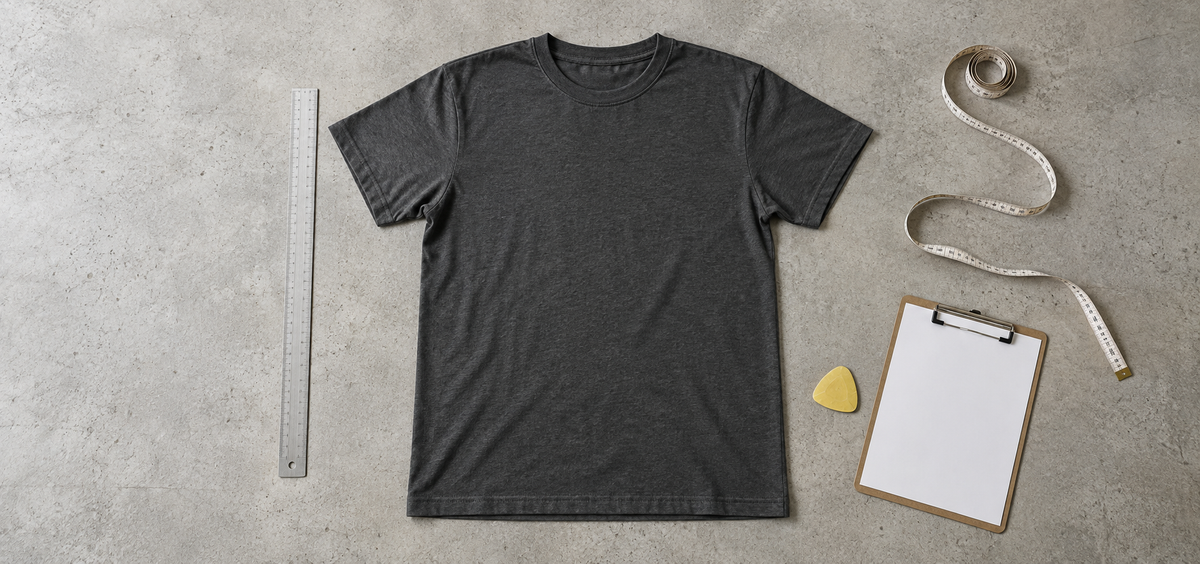
Garment shrinkage testing compares the same dimensions before and after an agreed laundering procedure. Identify the sample, define the measurement points, keep care and measuring conditions consistent, and record each result against criteria agreed before testing. A percentage without the sample identity, procedure and measurement direction is incomplete evidence for a production decision.
A T-shirt can meet its measurement chart before washing and lose the intended body length afterwards. A hoodie may retain its overall width while its hem or zipper area changes shape. A useful wash test records both dimensional change and the finished garment's appearance.
This guide helps clothing brands prepare a practical test brief and review record for washable garments. It is not a substitute for a complete published test method or a laboratory report. The objective is to make the evidence behind an approval clear enough for the brand and manufacturer to use.
1. Identify exactly what is being tested
Give each garment a unique sample ID. Record its style, size, color, fabric reference, finish, decoration and specification revision. Note whether it represents development, PP or bulk production. An early sample made in substitute fabric does not establish how the intended bulk material will perform.
Fabric evidence
A fabric test helps evaluate the material before it is cut. Keep the fabric lot and finishing reference attached to the result.
Garment evidence
A finished garment also includes seams, rib, closures, labels and decoration. Review how those components behave together in the tested construction.
Decide which materials, finishes and sizes need coverage, and how many specimens will be evaluated. A single sample's result belongs to that sample; it does not establish consistency across an entire order. Keep any unwashed reference clearly identified so it cannot be mistaken for a tested specimen.
2. Agree the laundering procedure before measuring
Write down the washing and drying conditions, number of complete cycles, and the points at which results will be recorded. Include the equipment or program, temperature setting, detergent and load details relevant to the agreed procedure. Record the preparation and conditioning requirements, including when measurements are taken after drying. Use the same arrangement when comparing candidates.
For a brand's development check, connect the procedure to the intended care instructions. If a buyer specifies a recognized method, confirm the exact method, edition and selected options with the test provider. Do not quietly replace a specified tumble-drying procedure with line drying and present the results as equivalent.
AATCC's laundering overview distinguishes dimensional-change evaluation from other appearance checks. TM135 covers fabrics; TM150 covers garments. The TM150 public summary also notes that some stretch-fabric garments may fall outside its applicability. A simplified worksheet does not demonstrate that either complete method was followed.
3. Measure the same points in the same way
Select dimensions that matter to the product's fit and function. For a tee, these might include body length, half chest and sleeve length. Name the endpoints, draw the measuring route and state whether a dimension is straight or curved. Keep units, fastening state and relaxed or extended condition consistent.
Record the original value from the actual specimen, not the size chart's target. After laundering and the agreed preparation, measure that specimen at the same points. Do not pull it back to the target dimension to obtain a better result. Resolve unclear readings by checking the method and repeating the measurement before making a production decision.
Place the diagram and measurement instructions in the current clothing tech pack. This keeps a wash-test result traceable when another person reviews the same sample.
4. Calculate dimensional change without losing the direction
Use a clearly labeled calculation for each measured point:
Dimensional change (%) = (after measurement − before measurement) ÷ before measurement × 100.
With this convention, a negative value means the dimension decreased; a positive value means it increased. Both measurements must use the same unit, and the starting value must be greater than zero. Keep the original readings so the calculation can be checked.
| Measurement | Before | After | Change | Reading |
|---|---|---|---|---|
| Body length | 70.0 cm | 67.9 cm | −3.0% | Length decreased |
| Half chest | 56.0 cm | 56.7 cm | +1.25% | Width increased |
The length example is (67.9 − 70.0) ÷ 70.0 × 100 = −3.0%. If another report states “3% shrinkage” as a positive magnitude, clarify its sign convention before comparing it with a dimensional-change column. Do not combine shrinking length and growing width into one average that hides either result.
5. Compare results with written acceptance criteria
Agree acceptable dimensional change and appearance requirements for the product before testing. Specify which measurements each limit covers, the laundering procedure and the reporting stage. There is no single shrinkage percentage that automatically approves every fabric, garment and fit.
CottonWorks' shrinkage guidance describes the influence of material construction, processing, finishing and care. It also explains that dimensional behavior can affect fit and the relationship between body fabric and trims. Review the actual finished combination rather than treating a fiber label or GSM value as a performance guarantee.
Photograph seam distortion, twisting, collar or rib changes, closure waviness and decoration appearance separately from the measurements. A dimension can meet its limit while the garment still needs correction for another reason. The T-shirt fabric and fit guide provides the wider material context.
Keep shrinkage limits separate from manufacturing measurement tolerances and grading decisions. A satisfactory wash result also does not approve the fit of every size; use the agreed size-set review for that evidence.
6. Keep a record that supports the next decision
Use the following fields as a development worksheet. Add the test provider's full report reference where formal testing is required.
Sample and specification
Sample ID; style and size; fabric and lot reference; color; finish; decoration; specification revision; stage represented.
Procedure and readings
Method or internal procedure ID; washing and drying conditions; cycle count; preparation conditions; measurement diagram; before and after values; units; calculated changes; operator and date.
Criteria and observations
Agreed limits by measurement; appearance requirements; photographs; any deviations from the planned procedure; result against each criterion.
Decision and follow-up
Approved, held or rejected; unresolved points; corrective action; revised sample reference; retest requirement; decision owner and date.
If a result is outside the agreed criteria, first check sample identity, care conditions, measurement method and arithmetic. Then investigate the material, finish or construction with the supplier. Do not solve an unexplained result by silently widening the limit or changing the pattern. Document any agreed revision and evaluate the revised sample.
Carry the accepted evidence into the PP sample approval record. If the bulk fabric or finish changes, confirm which checks must be repeated. Connect the approved requirements to the bulk quality-control brief, while keeping laundering evaluation separate from the inspection plan used to accept a shipment.
Frequently asked questions
How do you calculate garment shrinkage?
For dimensional change, subtract the before measurement from the after measurement, divide by the before measurement and multiply by 100. A negative result indicates shrinkage; a positive result indicates growth. Record the procedure and measurement point alongside the percentage.
What shrinkage percentage is acceptable for clothing?
Use criteria agreed for the specific material, product, fit and care procedure. Define the relevant measurements and appearance requirements before testing. A generic percentage is not an automatic pass limit for every garment.
Is AATCC TM135 the garment shrinkage test?
TM135 addresses fabric dimensional change after home laundering; TM150 addresses garments. Confirm applicability and the complete method with the test provider, especially for stretch constructions. A development checklist alone is not evidence of standard-method compliance.
Is one wash enough to approve a garment?
One cycle gives evidence only for that recorded cycle. Agree the number of cycles and reporting stages with the buyer or test provider. Do not describe a single-cycle check as proof of performance after repeated laundering.
Does pre-shrunk fabric remove the need to check garments?
Do not treat the description alone as an approval. Review evidence for the intended fabric and finish, then assess the finished garment and its components under the agreed procedure.
Can a garment pass measurements but fail the wash review?
Yes. Dimensions are only part of the agreed review. Twisting, seam distortion, closure behavior or decoration appearance may still need correction. Record those observations and the release decision separately.
Prepare your sample review brief
Send Lesstell your garment references, material specification, intended care instructions and required testing or approval criteria when planning development. Share your project brief so sample requirements and any testing arrangements can be confirmed for the project before production.