
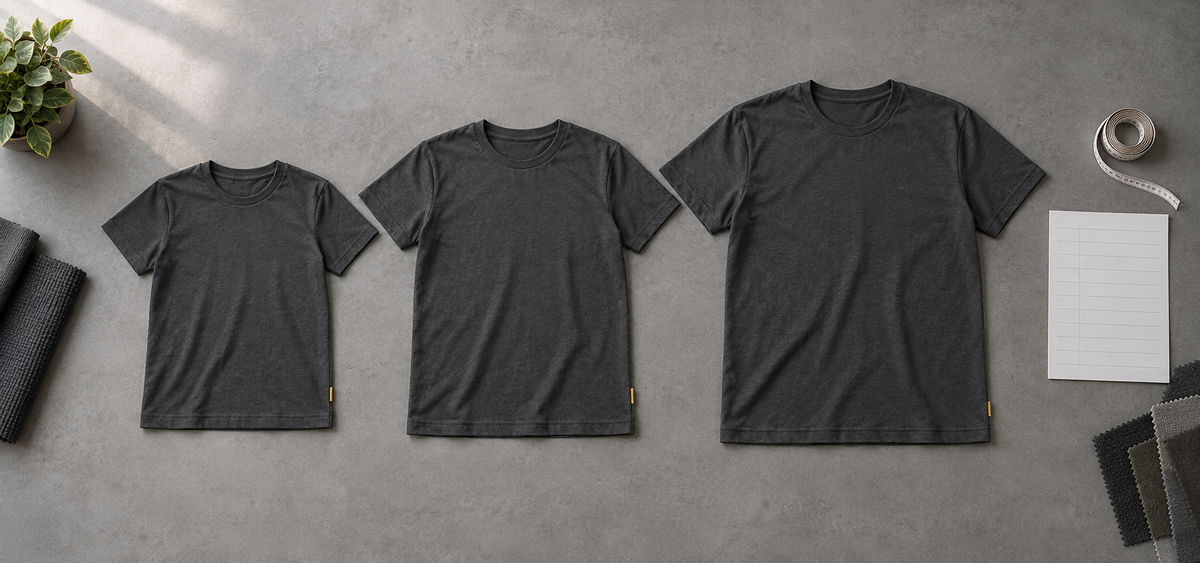
Clothing size set samples are physical garments made in an agreed selection of sizes to check how a style develops across its size range. A good base-size sample does not prove that every other size preserves the intended fit, proportion and function. Size-set review provides evidence for those separate decisions before bulk production.
Agree which sizes must be sampled, compare each garment with its own specification, assess it on a suitable wearer, and record the result by size. Resolve grading problems and define the scope of approval in writing. The checklist below is a recommended review framework; the actual sample quantity, size coverage and approval sequence must follow the project's written requirements.
Separate fit, size-set, PP and order-ratio decisions
Fit sample
Develops the intended shape, balance and movement, usually around the chosen base size. Approval of that garment does not automatically approve the graded range.
Size-set samples
Check selected sizes against the graded specification and intended fit. The review record should identify exactly which sizes and material conditions were evaluated, plus any remaining gaps.
PP sample
Confirms the production standard in the agreed bulk materials, trims and construction. Size-set and PP reviews may overlap, but their approvals should remain explicit rather than being assumed from one sample label.
Bulk size ratio
States how the order quantity is divided between sizes. It is a purchasing allocation, not evidence that those sizes have passed measurement or fit checks.
Use our fit and PP sample guide for the wider sampling sequence. Here, the question is which parts of the size range your evidence actually covers.
Agree full-size or selected-size coverage by risk
Start with the buyer's written sample requirements. If every size is required, a selected-size submission needs an agreed change to that requirement. Do not assume that sampling the smallest, middle and largest sizes is sufficient for every style.
For a project without a prescribed plan, use the following recommended discussion points to decide coverage with the pattern and production teams:
New or changed patterns
A new fit block, extended range or revised silhouette creates unanswered questions. Consider broader physical coverage, especially where the pattern approach changes between size groups.
Construction and materials
Check where stretch, stiff decoration, lining, elastic or closures could affect movement differently by size. One successful fabric or finish does not establish equivalence for every variation.
Existing evidence
A proven, unchanged block may support selected-size review if the buyer accepts that scope. Record what earlier approval is being relied on and what this submission still needs to prove.
List sampled and unsampled sizes, the reason for selection and who accepts any outstanding risk. Expand coverage when a problem suggests that the original selection missed a relevant size transition.
A grade rule is not a measurement tolerance
Grading develops larger and smaller patterns through defined changes from a base size. A grade rule controls how a pattern point moves between sizes; a tolerance states the permitted variation around a specified garment measurement. They answer different questions.
A measurement can fall within its tolerance while the style still has an unsuitable progression between sizes. Conversely, an incorrect measurement may come from sewing or measuring rather than the grade rule. Investigate the cause before changing the pattern.
Use separate fields for the target measurement, actual measurement, deviation and agreed tolerance. Compare adjacent-size targets and actuals, then review the pattern where progression looks inconsistent. Do not enlarge every dimension by one percentage or borrow another brand's tolerances. Keep the approved chart and methods in the current tech pack.
Combine measurement checks with wear checks
The Apparel Sector Skill Council's sampling training guide includes checking size-set garments against buyer specifications. Use the current specification as the reference for each size, then document any agreed exception.
For your own review session, keep these two records separate:
Measurement record
Identify the sample, size and specification revision. Use the same landmarks, units, fastening state and measuring method. Distinguish relaxed from extended measurements. Record whether the garment is as received or assessed after an agreed wash and conditioning procedure.
Wear record
Use a suitable wearer for each evaluated size and note the intended underlayer. Compare front, side and back balance, then movement relevant to the garment. Record pulling, restriction, excess volume, opening access and detail placement with labelled photographs.
Do not put every sample on the same person and treat the results as equivalent. A flat measurement pass also does not settle comfort or silhouette. For product-specific measurement landmarks, see the varsity jacket sizing guide.
Recheck related sizes after development changes
A correction approved in one size can affect connected pattern pieces and other sizes. If a sleeve, armhole, rise, waistband or opening changes, identify which relationships need another check. A fabric, finish or component change can also alter the evidence behind earlier fit approval.
Recommended response: record the change, identify potentially affected sizes and components, update the specification revision, then agree what must be remeasured or remade. Do not quietly apply a correction across the range and retain the old approval date.
If only one size fails, keep its result visible. Investigate whether it is an isolated garment issue, a measurement-method problem or a systematic pattern issue. Close the finding with evidence; a new photograph without a sample ID and revision can create more uncertainty.
Copy this size-set review record
Use one record per style and revision, with a separate measurement sheet for each submitted size. Adapt these fields to the agreed process:
Submission identity
Style / revision: [ ]
Sample IDs and sizes: [ ]
Fabric, finish and component versions: [ ]
Reference fit approval: [ ]
Coverage and evidence
Full range / sizes checked: [ ]
Unsampled sizes and agreed rationale: [ ]
Measurement sheet / method revision: [ ]
Wearer, underlayer and photo references: [ ]
Decision and follow-up
Result for each size: [ ]
Open issue / owner / required evidence: [ ]
Related sizes requiring recheck: [ ]
Approval scope / approver / date: [ ]
Keep the physical reference linked to its record. Mark superseded samples clearly and retain the agreed approval version so the next team does not choose whichever garment happens to be nearest.
Make the release decision specific
- Confirm the sampled sizes match the written coverage plan.
- Close measurement and wear findings, or document accepted exceptions and their limits.
- Identify the approved pattern, chart, materials and physical references by revision.
- State whether size-set approval also satisfies any PP requirement or whether PP remains outstanding.
- Separate sample approval from permission to cut or produce bulk.
Size-set approval is a development checkpoint, not an inspection of the finished order. Agree the later bulk quality-control plan separately. For Lesstell development discussions, send your range, base-size reference and proposed coverage to our cut and sew manufacturing team, or include them in a custom clothing project brief.
Clothing size set samples FAQ
What is a size-set sample in clothing manufacturing?
It is a physical garment submitted as part of an agreed group of sizes for checking grading, measurements and fit. The submission should name the sizes covered and the specification revision used.
Must a size set include every size?
Follow the written buyer requirement. When coverage is open for discussion, select it by pattern, range, material and construction risk. Document omitted sizes and the evidence supporting that decision; no three-size combination is universally sufficient.
Is size-set approval the same as PP approval?
No. Size-set review addresses the range; PP review addresses the production standard. They can be coordinated, but approving one does not automatically approve the other. Record which requirements each submission satisfies.
Can tolerance be used as the grade increment?
No. Tolerance is an allowed variation around a target; a grade increment is an intended change between sizes. Define and review them separately rather than using manufacturing variation to create the size progression.
What happens if one sampled size fails?
Record the failure and investigate its cause. Review connected sizes or components when the finding may be systematic. Require the agreed correction evidence before closing that size's approval; do not hide it within an overall pass.
Does a bulk size ratio replace size-set approval?
No. An order split tells the factory how many garments to make in each size. It does not show that those sizes meet the agreed specification or preserve the intended fit.