
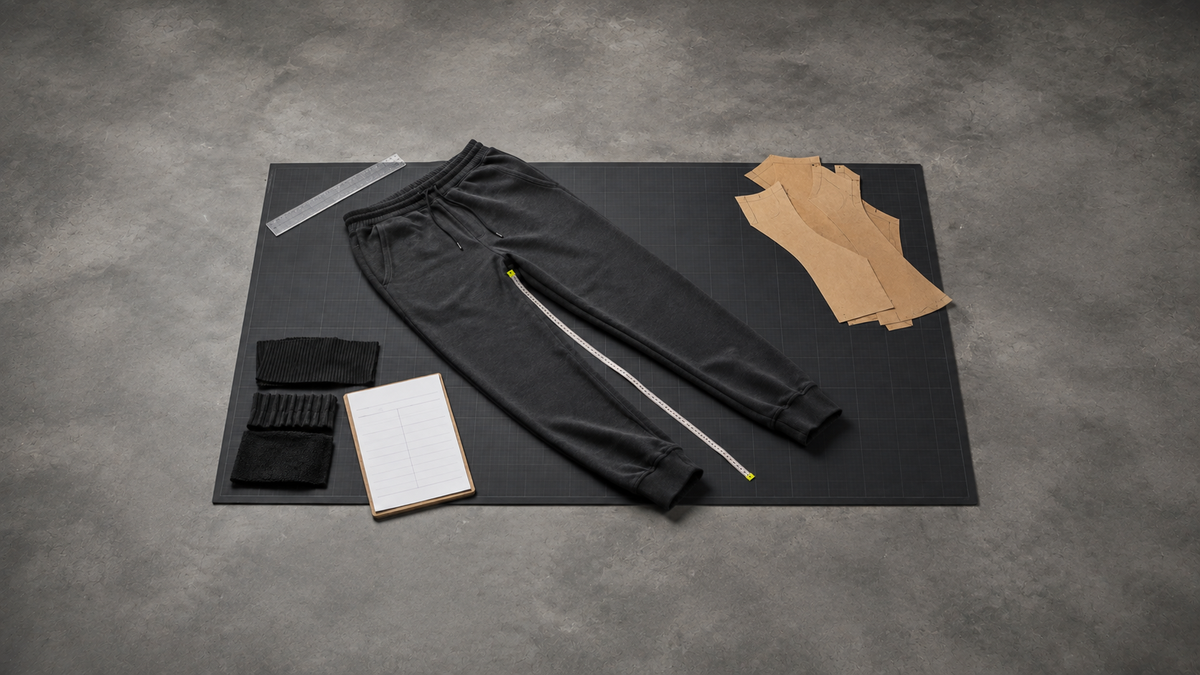
Custom joggers manufacturing starts with decisions about how the garment should sit, move and recover after wear. Fabric weight alone cannot specify a good pair of sweatpants. Brands also need a clear leg silhouette, repeatable measurement methods and an approved waistband, pocket and seam construction before bulk production.
For reliable custom joggers manufacturing, define the target wearer and silhouette, approve fabric in its intended finish, and document waist, rise, seat, leg and opening measurements. Record relaxed and extended waistband measurements separately. Then validate movement, laundering and size-range fit through samples. Bulk should follow one current tech pack and approved physical reference, not an unqualified instruction to “make premium joggers.”
Choose the leg shape before choosing the fabric weight
Start with where the waistband sits, the amount of seat and thigh room, the lower-leg shape and the intended break above the shoe. “Relaxed” describes ease; “open hem” describes the finish. They can coexist, so do not treat these terms as complete pattern instructions.
Tapered, cuffed jogger
Volume narrows towards the ankle. Balance thigh room, knee width and cuff entry so the lower leg looks controlled without restricting movement or making the foot difficult to pass through.
Straight or open-hem sweatpant
A less gathered opening changes drape and how length sits over footwear. Specify leg width and finished hem independently; simply removing the cuff from another pattern may not create the intended line.
Relaxed or wide-leg fit
Additional seat and leg volume needs deliberate rise, pocket position and length. Check the waistband remains secure without pulling the body of the garment into excessive folds.
Match fabric to the intended drape and use
Compare French terry, brushed fleece and relevant blends using a physical swatch and garment sample. Specify fibre composition, knit structure, finished weight, handfeel, stretch and the planned wash or finish. GSM describes mass per area; it does not establish softness, recovery or dimensional stability on its own.
A fabric that looks substantial on a table may feel bulky at the crotch intersection or waistband. Review those areas in the actual construction. Our streetwear fabric guide explains GSM, French terry and fleece without turning a weight number into a universal quality grade.
Write a jogger measurement specification, not a retail size chart
A consumer chart helps someone choose a size. A production specification tells the factory how to construct and check it. Give every point of measure a diagram, named reference points, measurement method, value by size and agreed tolerance. State whether each value is a flat half-width or full circumference.
Waist and waistband depth
Record relaxed and extended waist separately, plus finished waistband depth. Define whether measurement follows the top edge or another line, and whether elastic, drawcord and closures are relaxed or adjusted.
Front and back rise
Identify the crotch-seam junction and the exact waistband endpoint. State whether waistband depth is included and whether the tape follows the seam curve. Do not substitute a straight vertical distance without labelling that different method.
Seat and thigh
Mark the seat measurement level relative to a named waistband reference. For thigh width, define its position below the crotch and the line across the leg. “At the widest point” is not a repeatable instruction.
Inseam and outseam
Define the inseam from the crotch junction to the finished opening along the inseam. Record how cuff or hem depth is included. Outseam needs its own start point and cannot replace the inseam measurement.
Knee and leg opening
Locate the knee at a stated distance from a fixed reference. Define the opening as relaxed flat width, with any extension check separately specified. Match the method to rib cuffs, elastic cuffs or open hems.
Pockets and placement
Specify opening length, position and bag depth from stable seams or reference lines. Include back pockets, cargo pockets, decoration and drawcord exits where their location affects appearance or function.
Keep these definitions beside the flats in your clothing tech pack. A reference garment helps communicate intent, but mark which details should change rather than assuming every feature should be copied.
Measure relaxed and extended waist as different checks
For the relaxed waist, lay the garment flat, settle the gathers evenly and use the agreed measuring line without pulling the elastic. Record whether the value is half-width or circumference. Keep the drawcord untensioned unless the specification says otherwise.
For the extended waist, agree a controlled endpoint or test procedure with the manufacturer. Specify the applied force or extension condition, holding time and recovery check where relevant. “Pull as hard as possible” is neither repeatable nor a useful comfort assessment. Do not compare an extended measurement from one sample with a relaxed measurement from another.
Check the waistband on the intended wearer too: it must pass over the hips, sit at the intended height and remain comfortable when seated. No single flat waist number or universal extension percentage proves those things.
Approve waistband, pockets and crotch seams together
Specify elastic type, width, attachment and resistance to rolling inside its channel. Confirm drawcord length, routing, exits, tips and anchoring for the intended adult product. Test repeated adjustment and check whether hardware or seam bulk presses against the wearer.
Use the pockets while standing and sitting with the intended contents. Check opening access, gaping, bag security and whether the pocket distorts the front leg. Reinforcement locations should follow the design and stress points, not be added indiscriminately.
Assess crotch and seat seams during sitting, squatting and stepping. Seam choice must consider strength, required extension, bulk and comfort together. Agree thread, stitch construction and settings on the selected fabric; a generic “double stitch” instruction does not establish performance. Movement checks complement, rather than replace, agreed testing.
Compare dimensions before and after the agreed wash
Decide whether the production measurement standard applies before or after the specified finish. For laundering evaluation, record the same marked measurements before and after the agreed washing, drying, cycle count and conditioning procedure. Keep sample identification and measurement methods consistent.
AATCC TM150 addresses garment dimensional change after home laundering; its public scope also notes limitations for some stretch fabrics. Ask the testing provider to confirm the applicable method and current procedure. Naming a standard is not evidence that a garment has been tested.
For a clearly labelled calculation, use dimensional change (%) = (after − before) ÷ before × 100. Negative means shrinkage and positive means growth. If your report expresses shrinkage as a positive percentage instead, state that convention. Never mix the two signs or use the after-wash dimension as the denominator.
Also inspect leg twist, pocket distortion, waistband recovery and the relationship between body fabric and cuffs. CottonWorks explains that dimensional stability involves construction, processing and garment care, not just fibre selection. Agree acceptable results for the actual product; do not apply an arbitrary shrinkage limit to every fabric.
Separate base fit, size-set and PP approval
- Base-fit sample: develop the intended rise, seat, leg line and movement on a suitable wearer. Correct the pattern before extending it across the size range.
- Size-set review: agree which additional sizes need physical review, including relevant edge sizes. Check that grading preserves pocket access, rise balance, waistband function and the intended silhouette.
- Pre-production sample: approve the intended bulk fabric, finish, elastic, cuffs, pockets, decoration and labels against the current specification. Record any exception explicitly before authorising production.
Our PP sample approval guide explains these production decisions. Consolidate comments into one dated revision; conflicting comments across email, chat and an old spreadsheet create avoidable errors.
Define what bulk inspection must cover
Agree the inspection lot, size and colour coverage, critical measurements, defect definitions and acceptance rules before production. Include waistband function, left-right consistency, seams, pockets, leg twist, decoration and packing as applicable. A sample-based final inspection is not a promise that every piece is defect-free.
Use early-production checks to catch a repeated problem before it spreads, and the approved sample plus measurement specification to assess bulk. Keep the QC and AQL inspection plan distinct from development testing: passing a lot decision cannot correct a fit block that was approved incorrectly.
What to send for a custom jogger production review
- Target wearer, adult fit direction, base size and full size range.
- Front, back and detail references, with a current measurement chart and methods.
- Fabric, finish, waistband, drawcord, cuff and pocket requirements.
- Artwork, placement, labels and packaging specifications.
- Quantities by colour and size, destination and target launch date.
- Which details are fixed and which need development support.
Send that brief to our custom joggers manufacturing team. A new fit block can be developed through cut and sew manufacturing. Lesstell programs start from 50 pieces per style, subject to fabric, colour, decoration and trim requirements; confirm your actual split through our low-MOQ production options before committing the launch budget.
Custom joggers manufacturing FAQ
Which fabric should a brand choose for custom joggers?
Choose by intended drape, handfeel, use and finish, then approve a physical sample. French terry, brushed fleece and blends behave differently; GSM alone cannot establish comfort, recovery or wash performance.
Is an open-hem sweatpant the same as a relaxed jogger?
No. Open hem describes the leg finish, while relaxed describes added ease. Specify seat, thigh, knee, opening and length together so the factory can develop the intended silhouette.
Should jogger waist measurements be relaxed or stretched?
Record both when needed, as separate labelled checks. Define the relaxed measuring line and an agreed extension procedure. Never treat a stretched flat width as interchangeable with a relaxed width or body-waist measurement.
Is there a standard jogger size chart or tolerance?
There is no single chart or tolerance suitable for every brand and construction. Develop the base fit around your target wearer, then agree grading, measurement methods and tolerances for the relevant points.
How should wash-related sizing changes be evaluated?
Measure the same points before and after the agreed laundering and conditioning procedure. Record dimensional change, sign convention and baseline, then check twist and component behaviour as well as length and width.
What should be approved before bulk jogger production?
Approve the current specification and PP sample, including actual materials, construction, fit, branding and finishing. Resolve size-range risks and agree bulk inspection criteria before authorising production.