
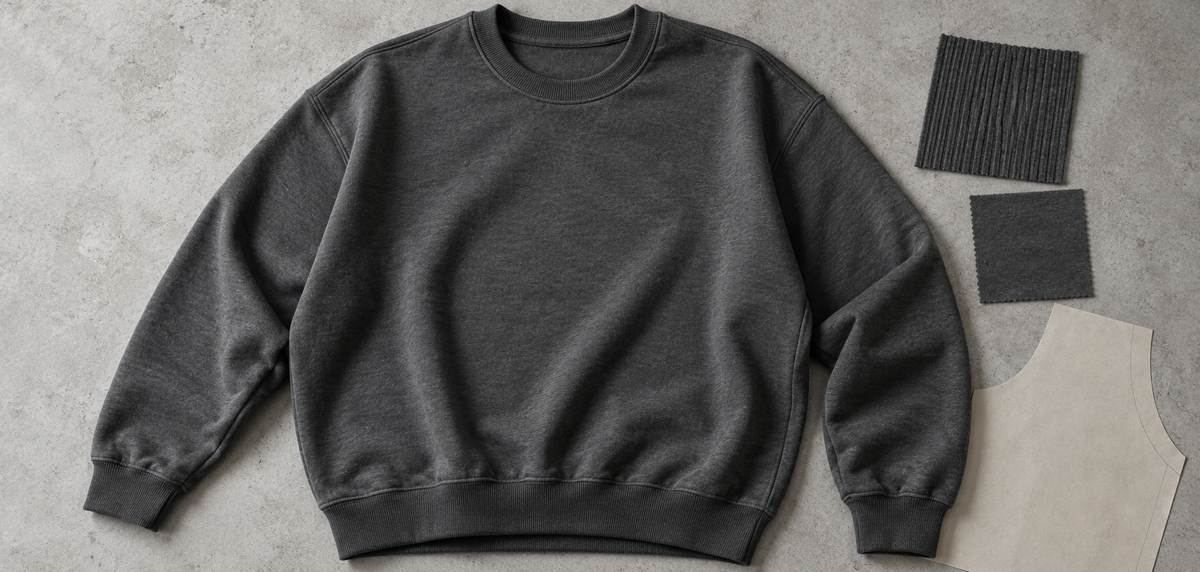
A crewneck sweatshirt can meet its chest measurement and still feel wrong when worn. The neck may resist pulling over the head, the cuffs may stay stretched, or a close-fitting hem may lift the body when the wearer raises their arms. These details need decisions before bulk cutting.
Quick answer: For custom crewneck sweatshirt manufacturing, approve the body fabric, rib and assembled seams together. Define the neck opening and recovery, cuff and hem shape, sleeve measurement method and decoration placement. Then review a physical sample, the required size set and a pre-production sample against one written specification.
1. Specify the rib as a separate component
“Matching rib” is not a complete instruction. Record its construction, composition, supplier reference, color and finished band height separately from the sweatshirt body. A matching shade does not establish matching stretch or wash behavior.
CottonWorks explains how rib structures open across their width and why they are used at necklines, wrists and waistbands. It also describes adding stretch yarn to help the fabric regain its shape. Those principles explain the role of rib; they do not give a universal neckband cutting ratio.
Ask the patternmaker to develop the band length for the selected material and neckline. Evaluate both 1×1 and 2×2 options by appearance, hand and sample performance if neither has been chosen. Do not approve a substitute only because its rib designation or fiber percentage matches the first swatch.
2. Approve the neck opening, not just its appearance
A crewneck needs to sit as intended at rest and allow comfortable head passage. Record neck width, front and back neck drop, visible rib height, and exactly where each measurement begins and ends. Clarify whether the neckline reference is the rib joining seam or the finished inner edge.
During a wear check, assess putting the sample on and taking it off, then inspect the collar after the agreed relaxation period. Note any distortion, residual opening growth or broken stitches. If repeat stretch testing is required, agree the method, extension or load, repetitions and recovery time; casual hand pulling is not a standardized test.
Inspect the assembled neckline again after the agreed washing and drying procedure. Coats identifies several causes of seam puckering, including uneven feeding, thread tension and differences in dimensional change between components. A wavy neck should therefore trigger a review of material, pattern and sewing together, rather than an automatic instruction to shorten the rib.
3. Make cuffs and the hem work with the silhouette
Specify relaxed cuff opening, finished cuff height and the intended sleeve gathering. Check whether the hand passes comfortably and whether the cuff returns to the approved shape. Review left and right cuffs together.
At the hem, decide how much the rib should draw the sweatshirt inward. A boxy, straight-hanging body and a blouson shape need different outcomes. Check the sample standing, seated and with arms raised; note where the hem settles afterward. Include the bottom band in the body-length instruction, or explicitly exclude it, so the supplier does not interpret a cropped measurement differently.
4. Use measurement methods that match the sleeve construction
Set-in, drop-shoulder and raglan describe different pattern arrangements. Do not compare their sleeve lengths as if they share the same starting point. The following are measurement conventions to agree with the patternmaker, not mandatory industry dimensions.
| Area | Define the method | Review on the sample |
|---|---|---|
| Set-in sleeve | Mark the shoulder-seam starting point and route to the cuff edge. | Shoulder placement, arm movement and sleeve reach. |
| Drop shoulder | Record shoulder width and sleeve length separately; define a total-reach check if needed. | How the extended shoulder and sleeve combine on the wearer. |
| Raglan sleeve | Draw the agreed neck or center-back starting point and route to the cuff. | Underarm room, seam position and reach without a conventional shoulder seam. |
| Body and bands | Show chest location, length endpoints, band heights and relaxed openings. | Balance, hem position and the intended amount of gathering. |
Add measurement diagrams, the garment's measurement condition and a tolerance for each relevant point. A single tolerance for every measurement may not suit the design. Use size-set samples to review the graded fit, particularly neck access, cuff openings and sleeve reach outside the base size.
5. Review fabric, decoration and washing together
Choose French terry or brushed fleece by the required feel, face appearance, weight and end use. Keep a physical reference; GSM alone cannot describe the finished hand or silhouette. Specify body and rib color together, including whether a contrast is intentional.
CottonWorks' knit-processing bulletin connects dimensional stability with knitting parameters, processing tension, relaxation and finishing. For the buyer, the practical check is the completed sweatshirt: measure body and band areas before and after the specified care procedure, recording length and width separately. Our garment shrinkage testing guide explains how to document that comparison.
For printing or embroidery, state artwork dimensions and placement from named reference points. Approve the intended technique on the selected fabric, then check the decorated garment for appearance, stiffness and distortion. Use lab dips and strike-offs for their respective color approvals; neither replaces fit approval or any required performance testing.
6. Turn sample comments into production instructions
Write each revision against a specific point: “reduce front neck drop to the revised specification” is clearer than “make the neck better.” Keep dated photos, measured results and the updated specification together, with a revision identifier that the supplier can follow.
- Materials: body and rib references, finish, color approvals, labels and approved substitutions.
- Construction: seam and topstitch appearance, band joins, neck tape if used, and decoration instructions.
- Fit: base-size measurements, graded specification, measurement diagrams and tolerances.
- Approval: physical sample reference, required checks, outstanding changes and written approval status.
Review the pre-production (PP) sample using intended production materials and construction. Identify any outstanding difference before approval. The approved sample is a production reference; it still needs to be supported by the specification, in-process checks and agreed final inspection.
Key takeaway
A well-specified crewneck links rib behavior, neck access, sleeve reach and wash results. Approve those relationships on the assembled garment before using the sample as the reference for bulk production.
Plan your crewneck development
For custom sweatshirt development with Lesstell, send your fit reference, material direction, artwork and quantities by color and size. For own-brand labels and packaging, include these in your private label development brief. MOQ starts from 50 pieces per style, subject to materials, decoration and order breakdown. Confirm sample fees and project lead times in writing; finalize the production schedule after materials and the PP sample are approved.
Frequently asked questions
Is 1×1 or 2×2 rib better for a crewneck sweatshirt?
Neither is automatically better. Choose the appearance and hand you want, then review the selected rib in the assembled neck, cuffs and hem. Construction names alone do not establish the required stretch, recovery or wash behavior.
What neckband-to-neckline ratio should a factory use?
Agree the ratio through pattern development with the actual rib and neckline. Record the approved band length, finished height and sewing construction. A ratio copied from another material is not a reliable approval rule.
Why can a crewneck collar become wavy after washing?
Possible contributors include differences in component shrinkage, sewing tension and fabric feeding. Compare the unwashed and washed samples, and ask the factory to assess the pattern, rib and seam together before deciding on a correction.
How should a drop-shoulder sweatshirt sleeve be measured?
Define the sleeve starting point and cuff endpoint in a diagram, and record shoulder width separately. If using a total-reach measurement, show its route too. An extended shoulder changes the relationship between sleeve length and where the cuff sits.
Does a crewneck need a size-set review?
The required sample sizes should be agreed for the project. A base-size approval does not establish how neck openings, cuffs or sleeve reach work across the full range. Use a size-set review to assess the selected graded sizes before bulk production.
What should be approved before bulk production?
Confirm the current specification, materials and color references, fit decisions, decoration, labels, required test results and PP sample. Record unresolved differences and approval conditions in writing, and agree the production and inspection plan.