
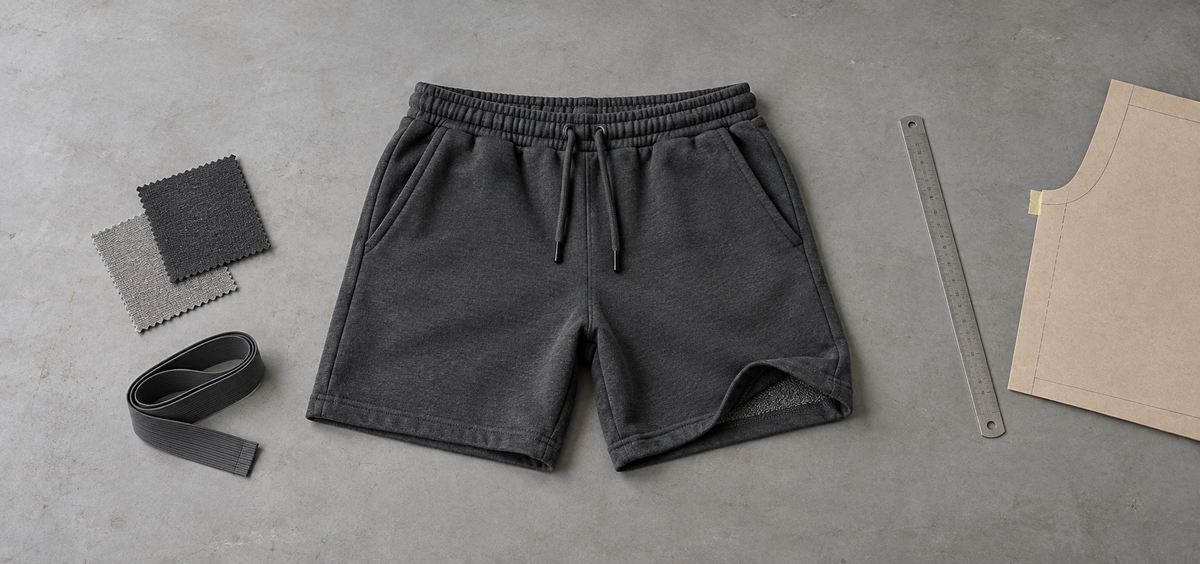
Custom sweat shorts manufacturing starts with the whole silhouette, not an inseam number. Define the wearing position, rise, seat room, leg opening and finished hem together. Then develop the selected knit fabric, waistband and pockets into a physical sample. Review it standing, sitting and after the agreed wash before approving the PP sample for bulk production.
This guide covers adult knitted sweat shorts for clothing brands. The checks below are a recommended development approach: turn each design intention into a named specification and a decision on the sample.
Choose fabric for the short silhouette
French terry and brushed fleece can both work, but compare the complete garment rather than choosing by GSM alone. Record composition, knit structure, finished weight, handfeel and finish. The streetwear fabric guide covers the basic material differences; here the decision is how the fabric behaves in a short, open leg.
Fold a swatch to the planned hem depth and layer it with the pocket material. Is the edge too bulky, or does it collapse against the thigh? Check opacity under the intended lighting and stretch. If the shorts belong to a matching set, approve the top and shorts together for shade and handfeel without assuming they need identical construction.
Balance rise, inseam and leg opening
Start by marking where the waistband should sit on the intended wearer. Two shorts with the same inseam can present differently when their crotch position, rise and wearing height differ. Cropping a sweatpant pattern also leaves its original pocket and seat relationships in place; those details need a fresh review.
Rise sets the upper shape
Define front and back rise, whether waistband depth is included, and the measurement endpoints. Check the front does not bunch and the back maintains the intended coverage when seated. Treat seat room and crotch shape as part of the fit decision, rather than adding rise everywhere.
Inseam sets one length
Specify the crotch junction to the finished hem along the inseam. Also record the finished side length (outseam), with a diagram showing whether it starts at the top or bottom of the waistband and ends at the finished hem. Identify the intended hem position on the wearer. A longer inseam cannot, by itself, correct a waistband worn at the wrong height or a crotch that hangs below the intended position.
Opening controls the leg line
State whether the opening measurement is a flat width or circumference. Assess it together with thigh ease and length: a roomy opening may create a boxier outline, while a narrow opening can catch during sitting. Check coverage in movement as well as the standing photo.
Review a base size first, then agree which other sizes need physical checks. Grading should preserve the intended proportions and coverage across the range; a single inseam increment cannot establish that.
Develop the waistband as a working assembly
Specify elastic width and construction, casing depth, attachment and drawcord routing. Distinguish an elastic that twists inside its casing from a waistband that folds over as a whole: record which happens on the sample before deciding what to change.
Check relaxed fit, access over the hips, seated pressure and recovery after repeated wear and adjustment. Agree a repeatable extension and recovery check if that feature is critical. A waistband that stretches far enough once has not demonstrated recovery.
For the drawcord, show the channel, exit position, length and tip treatment. Run it through the finished sample and confirm that attachment stitching has not trapped it. Check adjustment from both ends, whether the cord can disappear into the channel, and whether exits or seam intersections create uncomfortable bulk.
Keep pocket bags inside the intended silhouette
Short legs leave less room to hide a pocket bag. Specify opening position, usable depth, bag shape and its relationship to the hem; copying the pocket from a full-length trouser can leave the bag too close to the leg opening.
Choose an intended everyday item, such as the target phone size, for a practical check. Put it in the pocket while standing, sitting and stepping up. Look for gaping, a bag pulling below the hem, or a hard outline dragging the front leg out of shape. An empty flat sample may hide those problems.
If the bag shows while seated, review depth, angle, attachment and the leg opening together. Simply making the bag shallower may prevent the item from sitting securely. Approve the final pocket material with the body fabric too: a heavy bag or a strongly contrasting colour can change the appearance. Record the accepted pocket behaviour with photographs and comments.
Choose a hem that behaves like the reference
Define the finished edge, turn-up depth and stitching, including how the side seam meets the hem. Check both legs flat and on the wearer for flaring, tunnelling, uneven edges and unwanted curl. Ask whether the effect comes from the design, material or sewing setup before changing the pattern.
A raw edge needs an agreed reference for its appearance after laundering. A turned hem also needs a washed sample; pressing it flat for approval does not establish its later behaviour. If decoration sits near the opening, define its position from the finished edge and inspect the decorated sample.
Review the washed sample as shorts, not just measurements
Agree the washing, drying, cycle count and conditioning procedure before comparing samples. Measure the same named points before and after, then repeat the seated pocket and waistband checks. Look at the relationship between rise, inseam, opening and pocket bag, alongside twisting or hem distortion.
CottonWorks' guidance on shrinkage and skewing identifies fabric construction, processing, finishing and care among the factors affecting dimensional stability. A fibre label alone therefore cannot establish how the finished shorts will retain their shape.
AATCC TM150 addresses garment length and width changes after home laundering. Its public scope notes that certain stretch fabrics may fall outside its applicability. Choose a method suited to the selected fabric and agree the acceptance limits with your testing provider.
Close the sample decisions before bulk
Keep one dated tech pack with measurement diagrams, agreed tolerances, construction details and resolved comments. Mark any sample substitution clearly. A fit approval made in substitute fabric should not silently become approval of the final fabric, wash and trims.
Use the PP sample approval process to confirm the intended bulk version, including labels, decoration and pocket construction. Agree which dimensions and functional details production will check against that reference. Keep unresolved issues visible until the brand and manufacturer have agreed how to proceed.
A brief you can copy for development
Product: Adult knitted sweat shorts; intended wearer and use.
Fit: Wearing height, base size, size range and reference images.
Shape: Front/back rise, seat room, inseam, finished side length and leg opening, with defined measurement endpoints.
Material: Knit structure, composition, weight direction, handfeel, colour and finish.
Waist: Elastic, casing, attachment, drawcord route and adjustment requirements.
Pockets: Opening, usable depth, intended contents and seated appearance.
Hem: Edge construction, finished depth and decoration position.
Approval: Wash review, sample stages, quantities by colour/size and open development questions.
Send the brief for a custom shorts manufacturing review. For a new pattern rather than an existing blank, discuss cut and sew development. Identify which details are fixed and where you want manufacturing input.
Custom sweat shorts manufacturing FAQ
What fabric weight is best for sweat shorts?
There is no single best GSM for every design. Compare the selected knit, finish and pocket layers in the intended silhouette. Approve drape, opacity, bulk and washed appearance on a physical sample.
Is inseam enough to specify the length of sweat shorts?
No. Define wearing height, rise and the desired hem position alongside inseam. Check them on the intended wearer, because the same inseam can look different with another crotch position or fit.
How can a brand address a rolling waistband?
First identify whether the elastic twists inside the casing or the whole waistband folds. Review casing fit, attachment, elastic behaviour and seated pressure on the actual sample before choosing a correction.
Why can a pocket bag show below the hem?
The bag's depth, angle or movement may conflict with the short leg and opening. Check the pocket with intended contents while seated. Shortening the bag alone can reduce usable storage without solving the underlying fit.
Should a raw hem be approved before or after washing?
Review both states using the agreed care procedure. Record the intended edge appearance, curling and finished length. A deliberate raw edge still needs a clear approval reference for production.
What should be confirmed in the PP sample?
Confirm the current fit specification, intended materials, waistband, pockets, hem, decoration and labels. Resolve substitutions and wash-related changes in writing before approving that version as the reference for bulk.